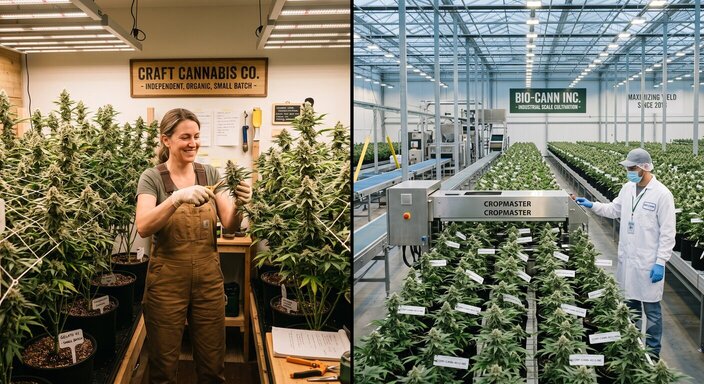
Walk into almost any dispensary in California, and you’ll face a wall of choices: budget-friendly pre-rolls, mid-tier eighths, and top-shelf jars with prices that raise eyebrows. Behind that spectrum is one of the most talked-about debates in the industry right now—craft cannabis vs. corporate cannabis. Are the premium products genuinely different, or is “craft” just a marketing word? This guide breaks down what the terms actually mean, what drives the price gap, and how to use that knowledge to shop smarter on Rebud.
Craft Flower Explained
“Craft” gets used loosely in cannabis retail, but it carries a working definition worth understanding before you browse any menu. At its core, craft weed refers to cannabis grown in small, controlled batches—with a focus on process quality over production volume.
What Craft Flower Explained Means and Why It Matters
Craft flower typically comes from independent cultivators who grow small batch cannabis, often in living-soil environments. A federally funded study found that soil biology can measurably affect THC, CBD, and terpene levels compared to conventional growing methods. Where mass-produced cannabis may be harvested mechanically and machine-trimmed to maximize throughput, craft producers tend to hand-trim their buds—preserving the trichome heads where terpenes and cannabinoids concentrate.
That attention at every stage—from genetics selection through cure time—is what separates craft flower from the commercial alternative. Small batch cannabis isn’t just a slower process; it’s a different philosophy. The goal isn’t the highest yield per square foot. It’s the best expression of a specific cultivar.
Terpenes are central to that conversation. These aromatic compounds shape flavor, aroma, and the overall character of a product—and they’re fragile. High-heat commercial drying degrades them quickly. According to slow-curing and terpene preservation, craft producers who slow-cure at controlled temperatures tend to deliver richer, more complex terpene profiles that you can detect the moment you open the jar.
What to Look For or Ask About in Store or on the Menu
When browsing cannabis products on Rebud, a few signals point toward genuine craft quality:
Living soil or organic cultivation noted in the strain description
Hand-trimmed designation—look for dense, intact buds, not leafy or machine-rounded
Terpene content listed on the label or product page, not just THC %
Cure date or harvest date visible on the packaging
Small batch or limited-run language from the brand
You can also read lab tests directly on many Rebud product listings—checking the terpene panel alongside the cannabinoid percentages tells you more than THC alone. If you’re unsure about any terminology, Rebud’s glossary covers all cannabis terms so you can browse with confidence.
Why Premium Cannabis Costs More
Small-batch cultivation isn’t cheap, and understanding where the cost goes helps contextualize what you’re paying for when you choose craft over commercial.
What Why Premium Cannabis Costs More Means and Why It Matters
California’s legal cannabis market is highly competitive. The California DCC 2024 Market Outlook Report found that legacy operators—many of whom pioneered craft cultivation practices—have faced significant cost pressures from compliance, licensing, and competition with large-scale corporate operators who benefit from economies of scale.
The price difference between boutique cannabis and an MSO cannabis product typically comes down to several factors:
Labor: Hand-trimming and individual plant monitoring require significantly more hours per pound than automated operations.
Inputs: Living soil, carefully selected genetics, and organic nutrients cost more than synthetic-feed hydroponic setups.
Yield: Smaller harvests with more cultivation attention per plant produce less total volume, which raises the per-unit cost.
Compliance: Independent operators in California carry the same per-license regulatory burden as large corporations, with fewer resources to absorb those costs.
MSO cannabis—cannabis produced by multi-state operators—can offer consistency and accessibility at competitive price points. The scale required to operate across multiple markets, however, often means standardized production processes that prioritize uniformity over individual batch expression.
What to Look For or Ask About in Store or on the Menu
Price alone isn’t a reliable quality indicator, but it’s a starting point. On Rebud, you can shop by cannabis effect, which helps you match products to your intended experience rather than defaulting to the highest THC number. A well-grown craft flower at 22% THC with a rich terpene profile will often outperform a mass-produced concentrate in terms of overall character.
If you’re exploring concentrates, the live rosin vs. live resin distinction is worth understanding—both are derived from fresh-frozen flower, but live rosin is solventless and typically produced in smaller craft runs. Similarly, the live resin vs. distillate comparison is a useful frame: live resin preserves the original plant’s terpene profile while distillate is refined down to concentrated THC. Both have their place, but the craft tier in concentrates usually sits firmly in the live rosin category.
Legacy Genetics vs. Exotics
The genetics conversation is where the craft vs. corporate divide gets most nuanced—and most interesting for consumers who care about what they’re actually consuming.
What Legacy Genetics vs. Exotics Means and Why It Matters
Legacy genetics refers to cultivars that have been selectively bred over decades, often originating from the pre-legalization California market. These strains—think OG Kush, Zkittlez, and their closely held phenotypes—carry genuine provenance. They were developed by the same legacy operators who built California’s cannabis reputation before the legal market existed.
Exotic genetics, by contrast, tend to be newer, highly sought-after crosses developed for standout visual appeal, extreme THC numbers, or novel flavor profiles. Both categories can be grown craft or commercially—but legacy cultivars are almost exclusively the domain of independent, small-batch producers.
Corporate producers have entered the exotics space aggressively, licensing popular genetics and scaling them in large indoor operations. The results can be inconsistent: growing an exotic cultivar at commercial scale often sacrifices the phenotype hunting and microclimate control that made those genetics distinctive in the first place. The global craft cannabis segment was valued at over $12 billion in 2026 and is projected to grow substantially, driven by consumers who specifically seek artisanal quality and unique genetics.
What to Look For or Ask About in Store or on the Menu
When evaluating genetics on Rebud:
Named phenotype (e.g., “Runtz #3” or “GMO Cookies S1”)—suggests a cultivator who hunted and selected, not just mass-produced
Cultivar exclusivity —single-source genetics from a specific farm signals a legacy or boutique cannabis breeding program
COA (Certificate of Analysis) —verify terpene and cannabinoid data matches the brand’s claims using the lab test feature on Rebud listings
Breeder credit —craft producers often list the seed company or breeding program, which helps trace genetic lineage
FAQ
What Is Craft Cannabis vs. Corporate Cannabis?
Craft cannabis refers to small-batch, artisan-grown flower and products produced by independent cultivators who prioritize quality, genetics, and process over volume. Corporate cannabis—often produced by large MSO cannabis companies or national conglomerates—prioritizes scale, consistency, and market reach. The distinction isn’t always about company size alone: some well-funded independent brands maintain genuine craft standards, while some smaller operations produce commercial-quality product.
How Does Craft Cannabis vs. Corporate Cannabis Compare to Craft Weed?
Craft weed is the informal term for the same category. “Craft cannabis” tends to appear in dispensary menus and industry reporting; “craft weed” is how most LA consumers naturally talk about it. Both terms point to the same thing: intentionally grown, small-batch cannabis that puts quality ahead of throughput.
What Does MSO Cannabis Mean?
MSO stands for multi-state operator—a cannabis company licensed and operating in more than one state. Leafly defines MSOs as companies that function similarly to franchise chains, bringing standardized branding and operations to multiple markets. In the LA market, you’ll find both MSO-owned brands and independent boutique cannabis producers on the same shelf. The label alone doesn’t tell you everything about quality, but it’s useful context when comparing products.
Where Can I Find Craft Cannabis vs. Corporate Cannabis Near Me in Los Angeles?
Rebud carries both—and the menu is built to help you tell them apart. Filter by brand, browse by category, or use the shop by cannabis effect feature to find products matched to your intended experience. When you want to go deeper, read lab tests on individual listings to compare terpene profiles and cannabinoid ratios. Whether you’re new to the category or a longtime craft weed shopper, Rebud’s product pages and glossary of all cannabis terms give you what you need to make a confident call.