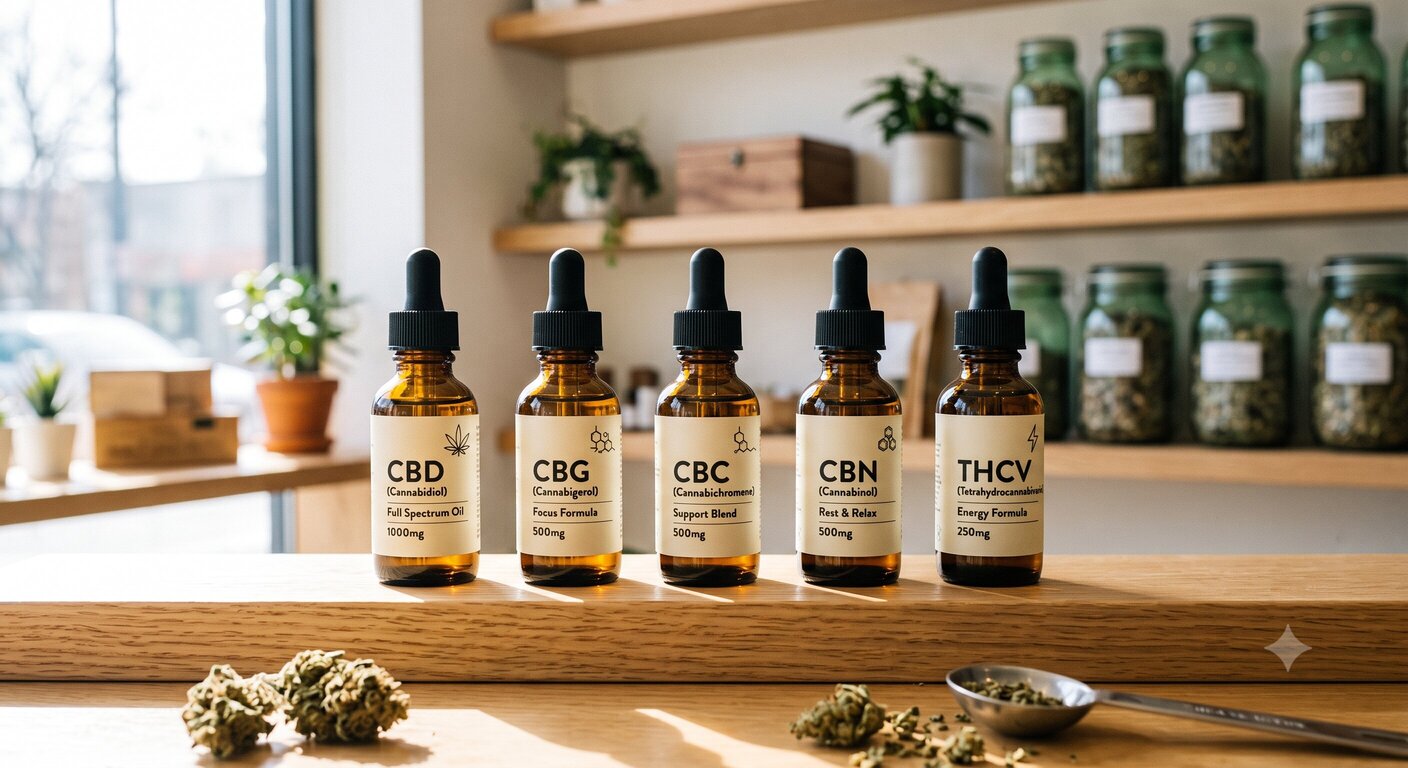
Most consumers shopping for weed products in Los Angeles have noticed that labels are getting more detailed. Alongside THC percentages, you're now seeing CBD, CBG, CBN, CBC, THCV — and sometimes CBDV. These are minor cannabinoids: naturally occurring cannabis compounds found in smaller concentrations than THC, but increasingly featured in beverages, gummies, sleep products, and wellness lines across the market.
Evidence for their effects varies widely by cannabinoid, and research is still developing. But if you're trying to make a more informed purchase at Rebud or anywhere else, here's a clear breakdown of each compound — what it is, what early research suggests, and what to look for at the dispensary.
CBD vs. CBG
CBD and CBG are the two minor cannabinoids you're most likely to see on packaging or menus at a licensed dispensary. Both are non-intoxicating — neither produces the high associated with THC — but they come from different chemical precursors and appear in very different product types.
How the Two Most Common Minor Cannabinoids Differ
CBD (cannabidiol) is the most widely researched of all cannabinoids beyond THC. It's commonly found in tinctures, topicals, capsules, and low-THC wellness products. Early research suggests it interacts with the endocannabinoid system differently from THC — without binding directly to CB1 receptors — which is why it doesn't produce intoxication.
CBG (cannabigerol) is sometimes called the "mother cannabinoid" because it is the chemical precursor from which THC, CBD, and other cannabinoids are synthesized as the plant matures. By harvest, most CBG has converted into those other compounds — which is why CBG-rich products require specialized cultivation and often carry a higher price. Early research into CBG is promising but limited, and should not be interpreted as medical guidance.
Unlike questions about Terpenes vs. THC Percentage — which center on aroma and raw potency — the CBD vs. CBG distinction is really about how each compound interacts with receptors in the body, and at very different parts of the plant's growth cycle.
What to Look For or Ask About in Store or on the Menu
Check the product's Certificate of Analysis (COA), not just the front label — it will list actual cannabinoid concentrations.
Ask your budtender whether the CBD or CBG in a product is full-spectrum, broad-spectrum, or isolate, as this affects the overall compound profile.
Rebud's team can walk you through current CBD and CBG options across categories — in-store at any of our LA locations or via delivery.
What Is CBN?
CBN (cannabinol) is one of the minor cannabinoids generating the most consumer interest right now, largely because of its association with sleep and nighttime use. It's worth understanding both what's known and what remains unproven.
Why CBN Is Associated with Evening/Nighttime Products
CBN forms as THC oxidizes — meaning it becomes more abundant in aged cannabis. It binds to CB1 receptors with less affinity than THC, producing milder psychoactive effects. Research into the effect of cannabis on sleep has explored CBN's potential role, and some early findings suggest it may contribute to a calming or sedating experience — particularly when paired with other cannabinoids and specific terpenes.
That said, isolated CBN research is still in early stages. Products marketed as "CBN sleep gummies" should not be read as a guaranteed sleep aid. The entourage effect — how multiple cannabis compounds work together — likely plays a significant role in any calming response observed.
What to Look For or Ask About in Store or on the Menu
CBN is most commonly found in gummies, tinctures, and capsules marketed for evening use.
Look for products that combine CBN with CBD or with terpenes like myrcene or linalool for a fuller compound profile.
Rebud carries a curated selection of nighttime-formulated weed products — ask the team for what's currently in stock.
THCV Explained
THCV (tetrahydrocannabivarin) is one of the more structurally unique cannabinoids beyond THC — and it's gaining attention in daytime and focus-oriented weed products.
What Makes THCV Different from THC
Despite the similar name, THCV behaves quite differently from THC at the receptor level. At lower doses, early studies suggest it may act as a CB1 receptor antagonist — essentially the opposite of THC's agonist behavior — with possible energizing effects. The science is still limited and should not be read as a guaranteed effect.
It's also worth clarifying what THCA is, since consumers frequently confuse it with THCV: THCA (tetrahydrocannabinolic acid) is the raw, non-decarboxylated precursor to THC that converts to THC when heated. THCV is a completely separate cannabinoid with different receptor behavior, different chemistry, and a distinct effect profile.
THCV is typically present in very small amounts in most strains. Products that feature it are usually specifically formulated or sourced from high-THCV cultivars.
What to Look For or Ask About in Store or on the Menu
THCV is most often found in vapes, tinctures, and daytime edibles.
Check the COA — many products that reference THCV contain very low concentrations, so verify before you buy.
Ask your Rebud budtender about THCV-forward products currently available on the menu.
CBC Explained Carefully
CBC (cannabichromene) is one of the lesser-discussed minor cannabinoids, but it's appearing with increasing frequency in full-spectrum products. Understanding what's known — and what isn't — matters here.
What's Currently Known (and Not Known) About CBC
CBC is non-intoxicating and does not bind strongly to CB1 receptors. Some early preclinical research suggests it may interact with TRP (transient receptor potential) channels, which play a role in pain and inflammation signaling — though this is early-stage science, primarily from in vitro and animal studies, and should not be interpreted as a treatment claim.
CBC has not been the subject of large-scale human clinical trials. It's one of the reasons full-spectrum products — which preserve a range of cannabis compounds including CBC — are often discussed in terms of the entourage effect rather than as isolated cannabinoid therapies.
What to Look For or Ask About in Store or on the Menu
CBC is rarely available as an isolated product; look for it in full-spectrum formulations.
If a product lists "cannabis compounds" or a "full-spectrum" extract, CBC may be present in trace amounts alongside other cannabinoids.
Your budtender can help identify full-spectrum weed products at Rebud across categories.
FAQ
What Are Minor Cannabinoids?
Minor cannabinoids are naturally occurring cannabis compounds found in smaller concentrations than THC. They include CBD, CBG, CBN, CBC, THCV, CBDV, and others. While present in smaller amounts, they're increasingly featured in formulated cannabis products for their potential distinct effects and the role they play in a product's overall compound profile.
How Do Minor Cannabinoids Compare to THC and CBD?
THC is the primary intoxicating cannabinoid in cannabis. CBD is the most abundant non-intoxicating cannabinoid and the most widely researched. Minor cannabinoids like CBG, CBN, CBC, and THCV each interact with the endocannabinoid system in their own ways — though with a much smaller research base than THC or CBD. Many consumers and formulators are interested in how these compounds work together (the entourage effect) rather than treating any one compound as a standalone solution.
What Does CBG Mean?
CBG stands for cannabigerol. It's often called the "mother cannabinoid" because it's the biochemical precursor to THC, CBD, and many other cannabinoids. CBG is non-intoxicating and is found in very low concentrations in most cannabis plants — which makes CBG-rich products more specialized and, typically, more expensive to produce.
Where Can I Find Products with Minor Cannabinoids Near Me in Los Angeles?
Rebud is a licensed cannabis dispensary and delivery service with locations across Los Angeles — including North Hollywood, Highland Park, Sylmar, and Westwood. Browse the full Rebud menu online or visit in-store to speak with our team about cannabinoid-specific product recommendations. We deliver across LA County and into parts of Orange County.