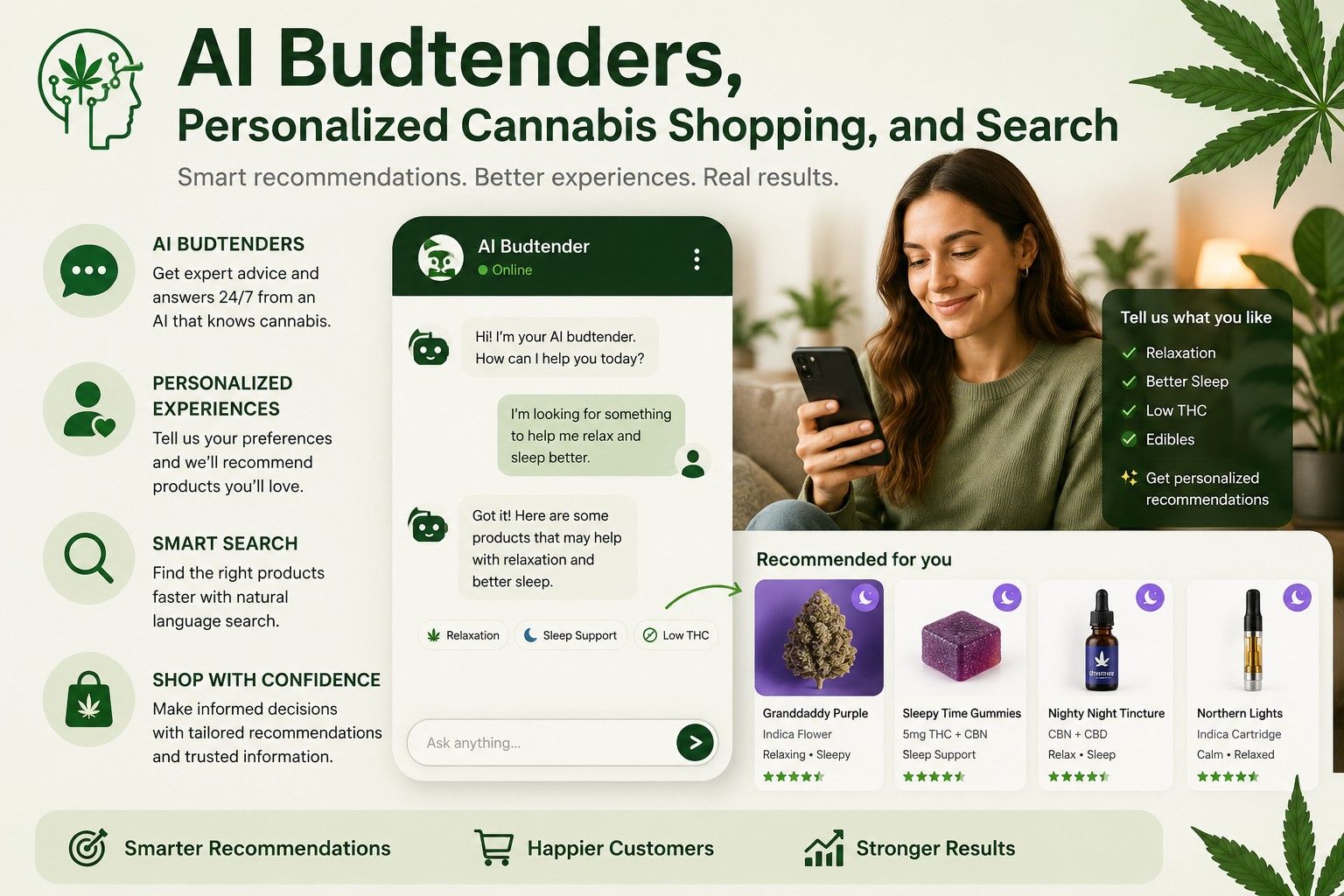
Ask a voice assistant "what's a good low-dose gummy for a chill night in" and you might get an actual answer now — not just a list of links. That shift is showing up in cannabis too, as AI budtender tools and smarter search start shaping how people discover products before they ever set foot in a dispensary.
This guide looks at how AI is changing cannabis AI shopping and search — how it compares to talking with a human budtender, what shopping by effect looks like when a recommendation engine is involved, and what this forward-looking shift means for how people find products online.
How Budtenders Recommend Products
Understanding where AI fits starts with understanding what a human budtender interaction actually looks like — since AI tools are largely trying to replicate parts of that conversation at scale.
What How Budtenders Recommend Products Means and Why It Matters
A human budtender typically asks a few quick questions — experience level, setting, past likes or dislikes — and matches that conversation to specific products in real time
This works well in person because a budtender can read context, ask follow-up questions, and adjust on the fly based on your response
AI budtender tools attempt something similar through structured questions or chat-based interfaces, often pulling from the same kind of information — potency, format, terpene profile — to generate a suggestion
The two aren't competitors so much as different tools for different moments — one is great for a quick starting point online, the other is better for nuanced, in-the-moment conversation
For the fuller picture on how staff recommendations actually work, our guide to how budtenders recommend products covers that process in depth
What to Look For or Ask About in Store or on the Menu
If you start your research with an AI tool, bring what it suggested into the store or delivery chat and ask a real budtender to weigh in
Don't treat an AI suggestion as final — it's a starting point, not a substitute for asking follow-up questions
Ask whether a dispensary's AI tool is trained on their actual current menu, or just general cannabis knowledge — that affects how useful the suggestion actually is
Shopping by Effect
Personalized cannabis recommendations — whether from a person or a tool — tend to work best when they're built around effect and experience rather than strain name alone.
What Shopping by Effect Means and Why It Matters
Shopping by effect means describing the experience you want (social, mellow, focused, etc.) rather than searching by a specific strain name
AI-driven dispensary AI tools often ask effect-oriented questions upfront, similar to how a good budtender conversation starts, then map those answers to terpene and cannabinoid profiles on the menu
This approach can be genuinely useful for AI cannabis shopping, since it doesn't require you to already know cannabis terminology to get a relevant starting point
As with human recommendations, this is about matching preferences and reported experience — not a guaranteed outcome or medical suggestion
What to Look For or Ask About in Store or on the Menu
Look for AI tools that ask about setting and desired experience, not just potency — a good weed recommendation engine treats those as connected
If a tool only ever recommends the highest-THC options, it's likely optimizing for potency alone rather than genuinely personalizing to your goals
Cross-check any AI suggestion with lab results or a quick question to staff before committing to a larger purchase
AI Search and Cannabis Education
Beyond product recommendations, AI is also changing how people find cannabis education content in the first place — which is part of why this topic matters for search behavior generally.
What AI Search and Cannabis Education Means and Why It Matters
More consumers are asking AI search tools direct questions ("how long do edibles take," "what's the difference between THCA and THC") instead of clicking through multiple articles
This shift rewards cannabis search intent-matched content that answers questions clearly and directly, rather than content built primarily around keyword density
AI product recommendations pulled from search tools are only as good as the underlying content they're trained on or referencing — which is part of why accurate, well-structured educational content matters more, not less, in an AI-driven search environment
This is a forward-looking shift in how people discover information and products — not a replacement for human expertise, budtender relationships, or in-store guidance
What to Look For or Ask About in Store or on the Menu
If you found REBUD through an AI search result or summary, feel free to ask staff to confirm or expand on anything the summary told you
Treat AI-generated cannabis answers as a starting point for a conversation, not a final word — especially on anything dosage or safety-related
If lifestyle content is what led you here, cannabis and creativity in music and art and cannabis and alcohol alternatives are two other places this kind of AI-assisted discovery often starts
Frequently Asked Questions
What Is an AI Budtender?
An AI budtender is a chat-based or search-driven tool that suggests cannabis products based on questions about your preferences, experience level, and desired effect — similar in concept to a human budtender conversation, but automated.
How Does an AI Budtender Compare to Cannabis AI Generally?
An AI budtender is a specific application of cannabis AI focused on product recommendations. "Cannabis AI" is the broader category, which also includes things like AI-powered search, content summarization, and educational tools beyond just shopping.
What Does AI Cannabis Shopping Mean?
AI cannabis shopping refers to using AI-driven tools — chatbots, recommendation engines, or smart search — to help identify products based on described preferences, rather than browsing a full menu manually or relying solely on in-person staff.
Where Can I Find AI Budtender Tools Near Los Angeles?
REBUD combines menu browsing with real staff support across our LA weed delivery and in-store experience. If AI-assisted shopping tools become part of our platform, they'll be designed to complement — not replace — direct conversations with our team.