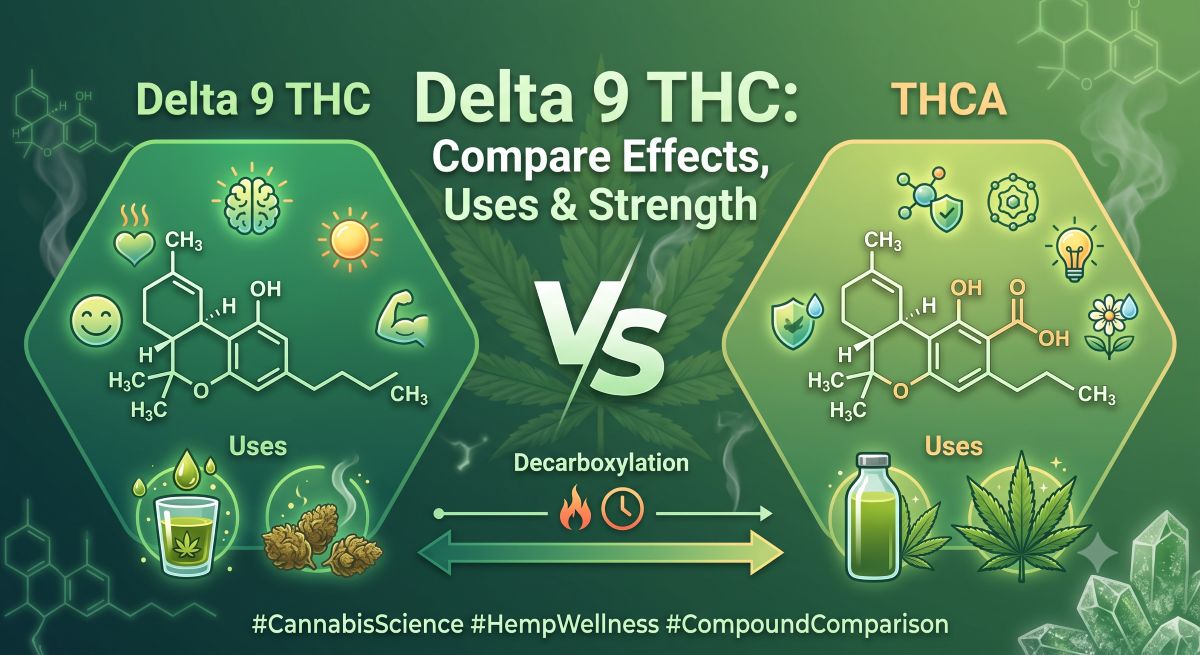
If you've spent any time browsing dispensary shelves or scrolling cannabis menus online, you've probably noticed two labels showing up everywhere: Delta 9 THC and THCA. They sound similar, they're chemically related, and they're often listed side by side on the same product page, which makes the delta 9 THC vs THCA question one of the most common ones shoppers ask before they buy.
The short version is that these two cannabinoids are closely connected but not interchangeable, and knowing the difference actually changes how you shop. Hemp-derived and high-THCA products have exploded in popularity over the past few years, showing up in flower, pre-rolls, concentrates, and vape carts across the market. That growth is great for variety, but it also means labels can be confusing if you don't know what you're reading.
In this guide, we'll break down what each cannabinoid actually is, how one turns into the other, what "potency" really means when you're comparing percentages on a label, and how California's rules apply to both. By the end, you'll be able to read any product label with confidence and pick the format that actually matches what you're looking for.
Are Delta 9 THC and THCA the Same Thing?
No, they're closely related but not the same. THCA is the raw, unheated cannabinoid that the cannabis plant actually produces as it grows. Delta 9 THC is what THCA becomes once heat is applied.
That distinction answers a question a lot of first-time shoppers have: is THCA the same as delta 9? Not in its natural state. Raw THCA is non-intoxicating on its own, while Delta 9 THC is the compound responsible for the classic cannabis experience.
Here's the rule of thumb worth remembering: once you apply heat, THCA effectively converts into Delta 9 THC. That means smoked or vaped flower delivers a Delta 9 experience regardless of which number is bigger on the label. A jar of flower can be labeled "28% THCA" and still produce a Delta 9 experience the moment it's lit, because heat does the converting for you.
What Is Delta 9 THC?
Delta 9 THC (delta-9-tetrahydrocannabinol) is the primary intoxicating cannabinoid in cannabis. When people say "THC," they're usually referring to Delta 9 THC.
Because it's already in its active form, products like vapes, edibles, beverages, and concentrates typically list Delta 9 THC (or total THC) on the label. Delta 9 gummies, for example, contain pre-activated THC that's measured in milligrams for consistent dosing.
What Is THCA?
THCA (tetrahydrocannabinolic acid) is the naturally occurring cannabinoid found in raw, unheated cannabis. In its natural form, it's non-intoxicating and is commonly found in flower, diamonds, live resin, and other concentrates.
When THCA is heated by smoking, vaping, dabbing, or cooking, it converts into Delta 9 THC through a process called decarboxylation. That's why high-THCA products deliver a Delta 9 THC experience once they're heated.
How THCA Turns Into Delta 9 THC
The process that converts THCA into Delta 9 THC is called decarboxylation, or "decarb" for short. In plain English, heat, whether from a lighter, a vape coil, or an oven, knocks a carboxyl group off the THCA molecule. That reaction releases carbon dioxide and leaves behind Delta 9 THC.
Everyday triggers for decarboxylation include:
-
Smoking flower or pre-rolls
-
Vaping oil or concentrate
-
Dabbing extracts
-
Cooking with cannabis, such as infusing butter or oil
Decarboxylation isn't only an on-demand event tied to a flame or a coil. Slow, partial conversion can also happen gradually over time from light and heat exposure during storage, which is one reason cannabis products are best kept in cool, dark conditions.
This directly answers a common question shoppers search for: does THCA turn into Delta 9 when smoked? Yes. Lighting flower or pulling from a vape applies enough heat to convert THCA into Delta 9 THC almost instantly.
Is THCA Stronger Than Delta 9 THC? (Potency Explained)
In raw form, no. THCA on its own is non-intoxicating, so comparing it directly to Delta 9 THC in terms of strength doesn't hold up until heat enters the picture. Once THCA converts through smoking, vaping, or dabbing, it becomes Delta 9 THC, so a high-THCA flower can deliver a comparable Delta 9 experience once it's actually used.
This is why chasing the single biggest number on a label isn't the best shopping strategy. Total THC, the product's format, and its terpene content all shape the final experience just as much as any one percentage does.
Why the Biggest THC Number Isn't the Whole Story
Two products can list the same total THC and still feel different in character. That's largely down to terpene profile and the presence of minor cannabinoids alongside the THC. Terpenes are the aromatic compounds responsible for a strain's smell and flavor, and different combinations are associated with different overall product character.
This is exactly why budtenders and product descriptions talk about terpenes and strain type as much as they talk about THC percentage. A label is a starting point for comparison, not the full picture.
THCA vs Delta 9 THC: Side-by-Side Comparison
Here's a quick side-by-side breakdown to make label reading easier at a glance:
|
Feature |
THCA |
Delta 9 THC |
|---|---|---|
|
Natural state |
Raw cannabinoid found in unheated cannabis |
Produced when THCA is heated |
|
Intoxicating in raw form |
No |
Yes |
|
Requires heat to activate |
Yes (decarboxylation) |
Already active |
|
Common product formats |
Flower, pre-rolls, diamonds, live resin |
Vapes, edibles, beverages, concentrates |
|
Label typically shows |
THCA percentage |
Delta 9 THC or "total THC" |
|
Onset once activated |
Minutes (inhaled) |
Minutes (inhaled) to hours (edibles) |
How Consumption Method Changes the Experience
The format you choose has a lot to do with which cannabinoid shows up on the label and how quickly you'll notice anything at all.
Flower and pre-rolls: Labels lead with THCA percentage since the product is sold raw. Heat from a lighter activates it on the spot, delivering fast onset once inhaled. Browse flower and pre-rolls categories to compare options.
Vapes and cartridges: The oil inside is typically already activated during manufacturing, so labels show Delta 9 THC or total THC instead of THCA. Vapes are portable and built for fast onset. Check out the vapes selection for cartridge options.
Concentrates (live resin, rosin, diamonds, badder): These are potent extracts pulled from the plant. Diamonds are near-pure crystalline THCA that converts on heating, while live resin and live rosin preserve more of the plant's original terpene profile, with rosin made using a solventless extraction process. Browse concentrates to see current options.
Edibles and beverages: Already activated and dosed in milligrams for precision. Onset is slower, commonly 30 minutes to 2 hours, and effects tend to last longer because of how the body processes them through digestion. See edibles and beverages for dosed options.
Wellness and topicals: This category exists for shoppers who prefer non-inhaled formats. Browse wellness and topicals to see what's available.
Whatever format you choose, a practical shopping habit worth keeping in mind is to start low and go slow, meaning begin with a smaller amount than you think you need and give it time before deciding whether to have more. It's simply a matter of controlling your own experience, especially with a new product or format. If you're picking up flower or concentrates, the accessories also has the gear you'll need to go with it.
California’s Rules for Delta-9 and THCA Products
California has its own regulatory framework layered on top of federal hemp law, and that combination is exactly what makes shopping here different from other states.
At the federal level, the 2018 Farm Bill defined legal hemp as cannabis containing no more than 0.3% Delta 9 THC by dry weight, which opened the door to a wide range of hemp-derived products nationally. California, however, applies its own state-specific regulations on top of that baseline, including rules from the state's Department of Cannabis Control and requirements introduced under AB 8, which affect how hemp and cannabis products can be sold and labeled in-state.
Because rules can differ depending on whether a product is sold through a licensed cannabis retailer versus general retail, it's always worth checking current requirements before you buy, rather than assuming federal hemp rules automatically apply the same way at the state level. For the latest official guidance, California's Department of Cannabis Control is the most reliable source, and this article isn't a substitute for legal advice.
This regulatory backdrop is also where delta 9 benefits are worth reframing. Rather than framing "benefits" around effects on the body, the real advantages for shoppers come down to product benefits: predictable dosing on labeled products, lab-tested potency and purity, and a wide variety of formats to choose from at a licensed dispensary.
Which Is Right for You? A Simple Shopper's Guide
Choose THCA if you:
-
Prefer raw cannabis in its natural form
-
Want flexibility to smoke, vape, or dab the same product
-
Enjoy flower as your go-to format
Choose Delta 9 if you:
-
Want an already-activated product with no extra steps
-
Prefer gummies or other edibles
-
Want a predictable, pre-measured dose
Neither option is "better" across the board. It comes down to which format fits how you like to shop and consume.
FAQ
What's the Best Way to Compare THCA and Delta 9 Products?
Start by considering the product format rather than just the label. Flower is typically labeled by THCA because it hasn't been heated, while edibles, vapes, and beverages usually list Delta 9 THC since they're already activated.
Does THCA Turn Into Delta 9 THC When Smoked?
Yes. Smoking applies enough heat to trigger decarboxylation almost instantly, converting THCA into Delta 9 THC as you inhale. This is true whether you're smoking flower or a pre-roll, and it's why raw THCA percentage isn't the same as the Delta 9 THC you actually experience.
Does THCA Get You High?
Raw THCA does not produce intoxication on its own. It only becomes active once heat converts it into Delta 9 THC, which is what happens the moment flower is lit or concentrate is dabbed.
Can You Buy Both THCA and Delta 9 Products at a California Dispensary?
Yes. Licensed California dispensaries like Rebud carry a variety of cannabis products, including THCA-rich flower, Delta 9 edibles, vapes, concentrates, and other formats, subject to state regulation