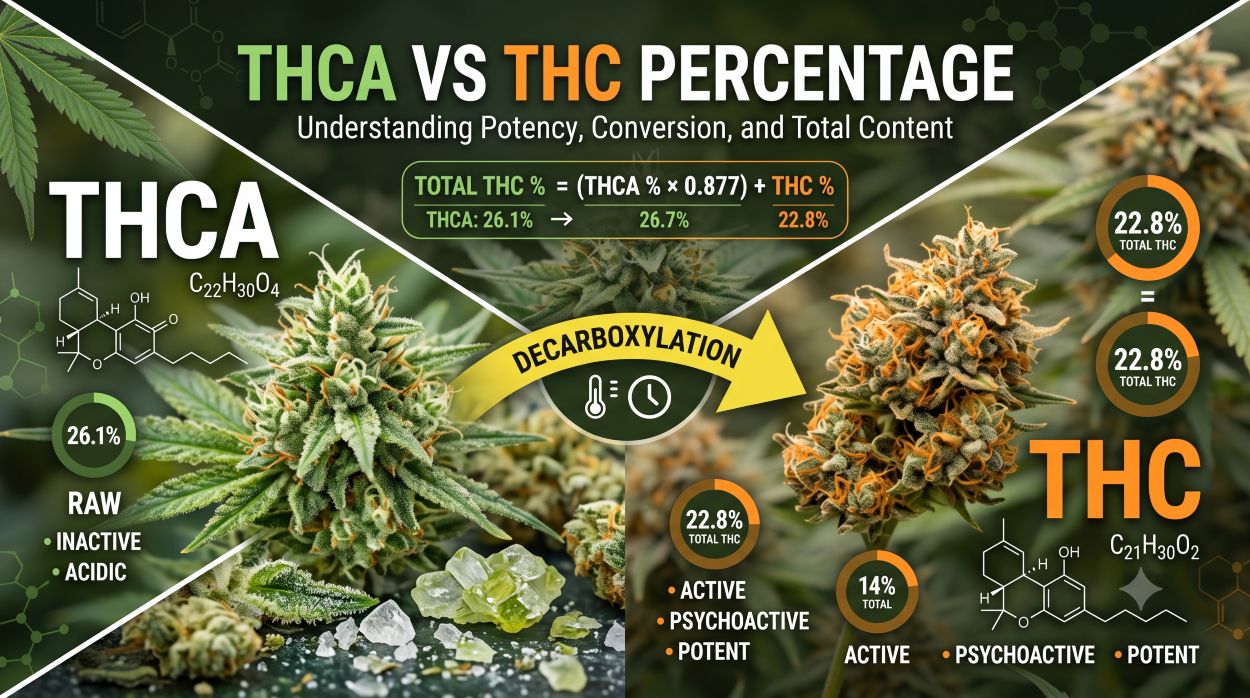
Walk into any dispensary and you will see two very different numbers on cannabis labels: a THCA percentage that can read 25 percent or higher, and a THC percentage that looks much smaller. It is a common source of confusion, especially for first-time buyers trying to compare products before they buy. This guide breaks down the THCA vs THC percentage question in plain terms: what each number actually measures, how one converts into the other, and which figure you should actually be comparing while shopping at Rebud.
THCA vs THC: What's the Actual Difference?
THCA and THC are related compounds, but they are not the same thing, and they are not interchangeable on a label.
THCA (tetrahydrocannabinolic acid) is the compound naturally present in raw, freshly harvested, and dried cannabis flower. It is non-intoxicating on its own. Lab testing on raw flower measures THCA percentage because that is the form the cannabinoid exists in before the flower is heated.
THC (tetrahydrocannabinol) is the compound created when THCA is exposed to heat. This is the intoxicating compound most people associate with cannabis effects.
A simple way to think about it: THCA is the raw ingredient, and THC is the activated form. Nothing has to be added to make the conversion happen - just heat.
Why Does THCA Percentage Always Look Higher Than THC Percentage?
THCA percentage looks higher than THC percentage because of a natural process called decarboxylation, and because raw flower is tested in its unheated state, before any conversion has taken place.
When flower is grown and dried, the cannabinoids it produces exist mostly as THCA, not THC. A lab testing raw flower reports the THCA number directly. THC percentage, by comparison, reflects what is left after heat drives off a carboxyl group from the THCA molecule, a process known as decarboxylation.
That conversion involves a small loss in molecular weight. Data needed on the exact conversion factor used industry-wide, though a commonly cited approximation is that around 87.7 percent of THCA converts to THC by weight. This is why raw flower labeled 30 percent THCA does not become 30 percent THC after heating. It becomes a smaller, but still significant, percentage.
How THCA Converts to THC
Decarboxylation happens when cannabis is exposed to heat, light, or extended time. It is the same basic chemical reaction whether it happens intentionally in a lab, or informally when flower is smoked, vaped, or baked into an edible.
When decarboxylation happens:
Smoking or vaping: the flame or heating element converts THCA to THC almost instantly as it is inhaled
Cooking or making edibles: flower needs to be decarbed in an oven at a lower, sustained temperature before it is infused into butter, oil, or other ingredients
Storage over time: light and heat exposure during storage can slowly convert some THCA to THC even without an active heat source, though this is a much slower process
Labs use a standard formula to estimate what the THC content will be once flower is heated:
Total THC = (THCA x 0.877) + THC
You do not need to run this calculation yourself. Reputable dispensaries and cultivators list "Total THC" directly on the label or Certificate of Analysis, so the math is already done for you.
Is High-THCA Flower Actually Stronger?
Not necessarily. A high THCA percentage does not automatically mean a stronger experience, because THCA percentage is only one part of what shapes how a product feels.
Several other factors play a role, including:
Terpene profile: The aromatic compounds in cannabis interact with cannabinoids and influence the overall character of the effects, not just the intensity.
Cannabinoid ratio: Flower with the same Total THC can carry different amounts of other cannabinoids like CBD or CBG, which shift the overall experience.
Consumption method: Smoking, vaping, and cooking all convert THCA at different rates and speeds, which affects onset and how the THC is delivered.
Individual tolerance: Two people trying the same flower can have noticeably different reactions based on their own tolerance and experience level.
This is why two flowers with a nearly identical Total THC number can still feel different from one another. The percentage on the label is a useful data point, not the full story.
What Is Considered a High THCA Percentage?
There is no official regulatory cutoff for what counts as "high," but general ranges are widely used across the industry to describe THCA and Total THC content in flower.
These ranges are a helpful starting point, but context still matters. Strain genetics, tolerance, and product type (flower versus concentrate) all affect how a given percentage actually feels in practice.
THCA vs THC Percentage: Which Number Should You Compare When Shopping?
When comparing potency across products, compare Total THC, not the raw THCA percentage, since Total THC accounts for the conversion that happens once the flower is actually used.
Total THC is typically listed on the label alongside THCA and Delta-9 THC, usually as its own line item or calculated value on the Certificate of Analysis (COA). Look for it specifically rather than relying on the largest number on the package.
Comparing THCA-only numbers between two different products can be misleading, since it does not account for differences in Delta-9 THC content that may already be present, or slight variations in how each product was tested. Total THC gives a more consistent basis for comparison.
How to Read a Cannabis Label Like a Pro
A lab-tested label usually includes several distinct figures, and knowing what each one means makes shopping much easier.
THCA: the raw, non-intoxicating cannabinoid percentage present before heating
Delta-9 THC: the small amount of already-active THC present in the raw flower
Total THC: the calculated figure representing potential THC content once fully heated
Terpenes: the aromatic compounds listed individually or as a total percentage
Cannabinoid panel: a broader breakdown that may include CBD, CBG, CBN, and other minor cannabinoids
A Certificate of Analysis, or COA, is the official lab report behind those numbers. It confirms the product was tested by a licensed, third-party lab and typically includes potency results along with screening for contaminants like pesticides, heavy metals, and microbials. Licensed California retailers are required to sell lab-tested product in line with state regulations, and you can review the state's testing and licensing standards directly on the California Department of Cannabis Control website.
At Rebud, COAs are available for the flower and concentrates we carry, whether you are shopping in-store or checking product details online before you visit.
THCA and THC Percentage by Product Type
How THCA and THC percentages appear on a label depends heavily on the type of product.
Flower
Flower is THCA-dominant in its raw form. This is the category where the THCA versus Total THC distinction matters most, since the label shows both figures separately. Browse Rebud's current flower selection to compare Total THC across strains.
Pre-rolls
Pre-rolls follow the same labeling logic as flower, since they are made from the same raw material. Standard pre-rolls reflect the flower's THCA and Total THC numbers directly, while infused pre-rolls add concentrate or kief, which raises the Total THC figure.
Concentrates
Concentrates, including live resin and rosin, generally carry a much higher Total THC than flower because the extraction process isolates cannabinoids at a higher concentration. Some concentrates also undergo partial decarboxylation during production, so the THCA-to-THC ratio can look different than it does on a flower label. Rebud's concentrates category page breaks down potency by product.
Edibles
Edibles are already decarboxylated before they reach the shelf, since they are made using cannabis that has already been heated during processing. This is why edible labels list THC content directly rather than showing a separate THCA number.
Frequently Asked Questions
Does THCA Get You High?
No, THCA on its own is non-intoxicating. It only converts into the intoxicating compound THC once it is exposed to heat through smoking, vaping, or cooking.
Is 30% THCA a Lot?
Yes, 30 percent THCA generally falls into the "very high" range for cannabis flower. After conversion, this translates to a Total THC percentage in the mid-to-high 20s, depending on the exact Delta-9 THC content already present.
Why Is My Flower Labeled THCA Instead of THC?
Flower is labeled with THCA because that is the form the cannabinoid exists in before it is heated. Since raw flower has not been decarboxylated, THCA is the accurate figure for what the lab actually tested.
Does Higher THCA Mean Stronger Edibles?
Not directly. Edibles are made from cannabis that has already been decarboxylated during production, so their labels show THC content rather than a raw THCA percentage carried over from the flower used to make them.
Is THCA Stronger Than THC?
THCA itself is non-intoxicating, so the comparison is not really about strength until after conversion. Once heated, the resulting THC is what determines intoxicating effects, which is why Total THC is the more useful number for comparing potential strength.
Why Is THCA Percentage Higher Than THC Percentage?
THCA percentage is higher because decarboxylation causes a slight loss in molecular weight as THCA converts to THC. Raw flower is also tested before this conversion happens, so the reported THCA number is naturally larger than the resulting THC number.
How Much THC Comes From THCA?
Using the standard conversion formula, roughly 87.7 percent of THCA's weight converts to THC. Data needed to confirm whether Rebud's supplier labs apply this exact conversion factor uniformly across all products.
What Percentage Is Considered a High THCA Flower?
Flower with a THCA percentage of 25 percent or higher is generally considered very high, while 20 to 25 percent is considered high. These are general industry ranges rather than fixed regulatory thresholds.
Should I Buy Based Only on THC Percentage?
Not exclusively. Total THC percentage is a useful comparison tool, but terpene profile, cannabinoid ratio, and consumption method also shape the overall experience, so it is worth considering the full label rather than one number alone.
Shop Lab-Tested Cannabis at Rebud
Every strain and concentrate at Rebud is tested and labeled with a full cannabinoid panel, so you can compare THCA, Delta-9 THC, and Total THC before you decide what to buy. Ask a team member in-store for a Certificate of Analysis on any product, or check product details online ahead of your visit.