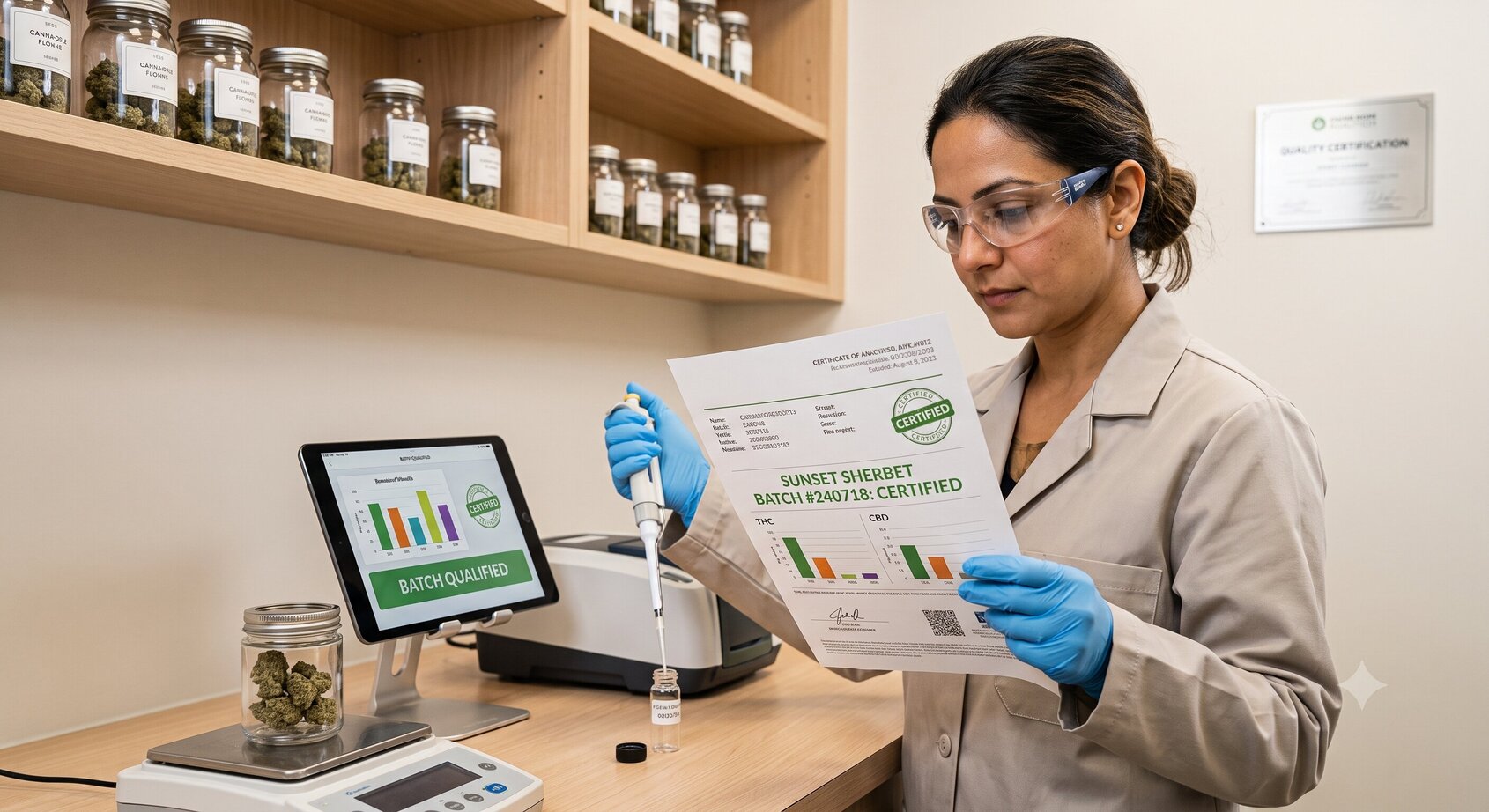
Every cannabis product sold at a licensed dispensary in California comes with a paper trail. That trail is called a Certificate of Analysis (COA), and it's more than just regulatory paperwork. It's the clearest window you have into exactly what's inside the product you're about to buy: how potent it is, what terpenes give it its character, whether any pesticides or heavy metals were detected, and whether it passed microbial testing before it ever reached a shelf.
For Los Angeles cannabis consumers, interest in lab testing has grown sharply alongside the legal market. As more people move away from unregulated sources, they're asking better questions — and a cannabis lab test is often the best place to find answers. California requires third-party testing for all licensed cannabis products before they can be sold, which means every item on the Rebud menu has passed a state-mandated safety review before it reaches you.
This guide breaks down how to read a COA from top to bottom — no chemistry background required. Whether you're buying for the first time or you've simply never paid close attention to what those numbers actually mean, you'll leave here knowing exactly what to look for.
How to Read a COA
A COA is an official document issued by an accredited, state-licensed laboratory. It contains everything regulators, retailers, and consumers need to confirm that a product meets California's safety and accuracy standards. If you've ever scanned a QR code on the back of a cannabis package and landed on a lab report, that's the COA. Most licensed retailers, including Rebud, make these accessible on product pages or through in-store staff on request.
Key Sections of a Certificate of Analysis
A standard COA is organized into clearly labeled panels. Here's what you'll find and what each one means:
Sample Information: Product name, batch number, strain type, product format, and the names of the brand and testing laboratory. This confirms the report matches the specific product you're looking at — not just the strain or brand in general.
Potency Panel: Shows the full cannabinoid profile — primarily THC and CBD, but often extending to minor cannabinoids like CBN, CBG, and THCV. Both THCa and delta-9 THC are listed separately; "Total THC" accounts for the conversion of THCa to active THC when heat is applied.
Terpene Profile: Lists the terpenes present and their concentrations as a percentage of total weight. Common terpenes include myrcene, limonene, caryophyllene, and linalool, each associated with distinct aromatic and sensory qualities.
Pesticide Screen: A pass/fail panel covering dozens of compounds regulated under California law. A passing result means no prohibited cannabis pesticides were detected above the state's action limits.
Heavy Metals Panel: Tests for lead, arsenic, mercury, and cadmium. Cannabis plants are bioaccumulators — they absorb metals from the growing medium — making this panel especially important for flower and concentrate products.
Microbial Testing: Screens for harmful pathogens including Salmonella, E. coli STEC, and Aspergillus species. Required for all product types sold through licensed channels.
Residual Solvents (concentrates and vapes only): Confirms that any solvents used during extraction have been purged below safe concentration limits.
Water Activity / Moisture Content: Relevant for flower and edibles. High moisture creates conditions favorable for mold growth during storage and transit.
What to Look For or Ask About in Store or on the Menu
Check that every panel shows "Pass." A single fail means the batch cannot legally be sold in California. Beyond that, look at the test date — COAs are batch-specific, and a recent date on a current lot is a better reflection of what's actually on the shelf. If you're choosing between products, the terpene panel gives you far more useful information than the THC number alone.
If you're in-store or placing a delivery order and can't locate a COA, just ask. Every licensed product in California has one on file.
What California Cannabis Testing Means
California operates one of the most tightly regulated cannabis testing frameworks in the country. All licensed cultivators, manufacturers, and distributors must submit products to an independent, state-accredited laboratory before those products can enter retail — no exceptions. This is third-party verification, not self-reported data, conducted by labs independently licensed and overseen by the California Department of Cannabis Control (CA DCC). Understanding what's actually tested helps you interpret results with confidence.
State-Required Testing Categories Explained
The California DCC mandates testing across the following categories for every licensed batch:
Cannabinoid Potency: THC, CBD, and all detectable cannabinoids must be accurately represented on product labeling within a defined variance range.
Terpene Profile: Required for most product types and used by many consumers to guide purchasing decisions.
Residual Pesticides: Tested against a state-maintained list of over 66 compounds. California's allowable limits for cannabis pesticides are among the strictest of any regulated cannabis market in the United States.
Heavy Metals: Lead, arsenic, cadmium, and mercury are measured using ICP-MS (inductively coupled plasma mass spectrometry), a method capable of detecting trace amounts at the parts-per-billion level.
Microbial Contaminants: Tests for Salmonella, E. coli STEC, Aspergillus niger, flavus, terreus, and fumigatus, as well as total yeast and mold counts. All must fall within defined limits before a product advances to retail.
Residual Solvents: For vape cartridges and concentrates, over 20 solvent compounds are screened against individual action limits.
Mycotoxins: Aflatoxins and ochratoxin A — mold-derived compounds with established toxicity thresholds — are tested for all applicable product types.
Water Activity and Moisture Content: Prevents product degradation and inhibits mold formation during distribution.
Together, these requirements mean every legal California cannabis purchase carries a verified safety record. When you see a COA with all panels marked "Pass," you're looking at confirmed compliance with state law — not a brand claim.
What to Look For or Ask About in Store or on the Menu
One detail worth noting: the testing laboratory's name appears on every COA. California's DCC licenses labs independently, and a legitimate report should come from a facility on the state's active accreditation list. For most purchases through a licensed retailer like Rebud, this is validated upstream — but it's useful context if you ever receive a report from an unfamiliar source.
For edibles dosing specifically, the potency panel is the most critical section to review. It confirms whether the milligrams per serving stated on the label reflects what was actually measured — a meaningful accuracy check that unregulated edibles simply cannot offer. California requires edible potency results to fall within a specified variance, which directly affects how reliably you can plan your experience.
Potency Testing vs Terpene Testing
Potency gets most of the attention — and for good reason. THC percentage is the first number most people look for on a product page or package. But experienced consumers and cannabis researchers increasingly argue that terpenes may be equally important to the overall experience. Understanding how these two panels work together gives you a more complete picture of what to expect before you buy.
Why Both Numbers Matter for the Experience
Potency testing quantifies the cannabinoids in a product. Total THC is the headline figure — expressed as a percentage by weight for flower and concentrates, or as milligrams per serving for edibles and beverages. But THC percentage alone does not reliably predict how a product will affect any given person. Tolerance, consumption method, metabolism, and context all play significant roles.
Terpene testing identifies and quantifies the aromatic compounds that define a strain's scent, flavor, and potentially its character. Research published in Frontiers in Pharmacology and related peer-reviewed journals points to a synergistic relationship between terpenes and cannabinoids, often described as the "entourage effect." Myrcene, one of the most abundant cannabis terpenes, is associated with a grounding, settling feeling. Limonene trends toward something more uplifting. Caryophyllene is unique in that it also binds to CB2 receptors, making it the only known terpene to interact directly with the endocannabinoid system.
This distinction matters most when choosing products for specific purposes. Someone interested in cannabis and microdosing, for example, may care more about terpene profile and minor cannabinoid ratios than peak THC — since the goal is a subtle, controlled effect rather than maximum potency. In those cases, the terpene panel and the full cannabinoid breakdown are both worth reviewing before you decide.
Shopping by desired experience rather than category or potency rank alone is increasingly how informed cannabis consumers approach the menu — and the COA is what makes that kind of decision-making possible. For plain-English definitions of terms you'll encounter across both panels, a cannabis academy glossary is a practical reference to have open while you read a lab report.
What to Look For or Ask About in Store or on the Menu
When comparing two products with similar THC percentages, pull up both COAs and look at the terpene panels side by side:
Total terpene percentage: A higher overall figure generally means a more expressive aromatic and sensory profile. Some flower lots test above 3–4% total terpenes; others fall below 1%.
Dominant terpene: The compound at the highest concentration tends to have the most noticeable influence on character. Two products at 25% THC can feel meaningfully different if one is myrcene-dominant and the other is limonene-dominant.
Terpene variety: A broader spectrum may contribute to a more complex, layered profile compared to a report dominated by one or two compounds.
For manufactured Cannabis products — edibles, vapes, beverages — terpene content is often lower than in fresh flower due to heat and processing. Some producers reintroduce terpenes after extraction, which will appear in the COA results. Ask your Rebud budtender or delivery team to pull up COAs side by side when you're choosing between two products. It takes about 30 seconds and tells you far more than strain names alone.
FAQ
What Is a Cannabis Lab Test?
A cannabis lab test is an independent chemical analysis conducted by a state-licensed, accredited laboratory. In California, third-party testing is a legal requirement for all licensed cannabis before it can enter retail. Tests cover potency, terpenes, pesticide residues, heavy metals, microbial contaminants, residual solvents, and other safety markers. The complete results are compiled into a Certificate of Analysis (COA), which is batch-specific and tied to a traceable production lot.
How Does a COA Compare to a Certificate of Analysis?
They are the same document. COA is simply the standard abbreviation for Certificate of Analysis. You will see both terms used interchangeably on packaging, product pages, and lab reports. A cannabis COA is issued by the testing laboratory after a batch passes all required panels and serves as the official compliance record for that production lot. At Rebud, COAs are available for every product on the menu.
What Do Cannabis Pesticide Test Results Mean?
California's DCC regulates a list of pesticides that are prohibited or subject to strict limits in licensed cannabis cultivation and processing. When a COA includes pesticide results, each compound is measured against an established action limit — the maximum concentration permissible under state law. A Pass result means no prohibited cannabis pesticides were detected above those limits. A Fail means the product cannot legally enter retail. Most COAs list every tested compound individually alongside the action limit, so you're reading actual measured data — not just a summary. For the full list of regulated compounds and California thresholds, the Department of Cannabis Control publishes its testing requirements at cannabis.ca.gov.
Where Can I See Lab Test Results for Products Near Me in Los Angeles?
If you're shopping at Rebud — in-store at North Hollywood, Highland Park, Sylmar, or Westwood, or placing a delivery order — you can request COAs for any product you're considering. Many are accessible directly via QR code on product packaging. Browse the Rebud menu online to explore available products by category, and ask any in-store staff member to pull up a COA on the spot. For the fullest picture before you buy, pairing the lab data with any terpene or experience notes on the product page gives you both the safety record and the context to make a well-informed choice.