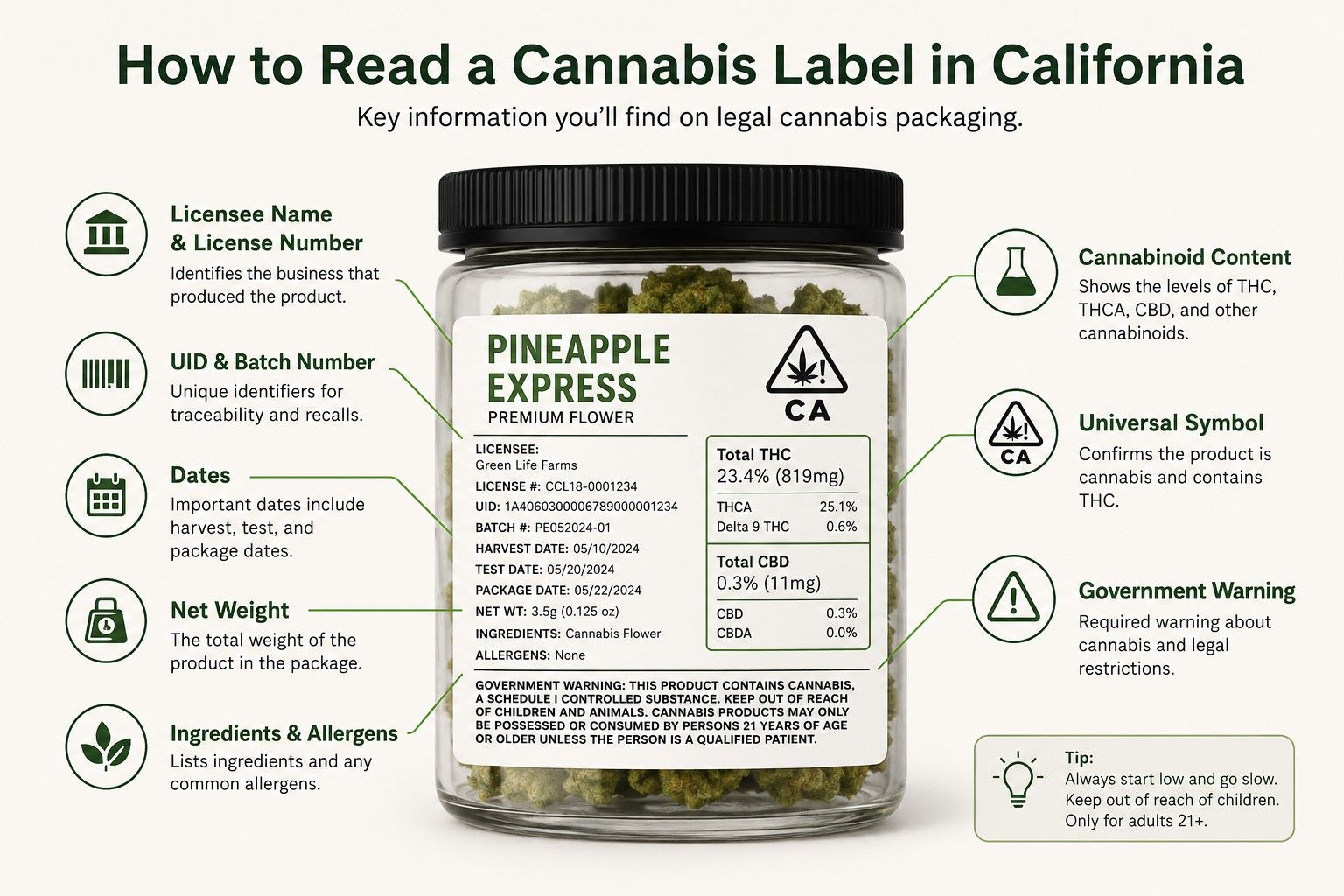
Pick up almost any legal cannabis product in California, and you'll find a label packed with numbers, warnings, and abbreviations — THC, THCA, batch codes, a triangle warning symbol, serving size, testing dates. It's a lot, and it's not always obvious what actually matters when you're deciding what to buy.
This guide breaks down how to read a cannabis label the way California requires it to be printed, what the numbers actually mean, and what's worth double-checking before you order. Whether you're picking up flower, an edible, or a vape, knowing how to read a weed label helps you shop with more confidence and fewer surprises once you get home.
THCA on Labels
If you've looked closely at a flower label recently, you've probably noticed two THC-related numbers instead of one — and that's not a mistake.
Why THCA and THC Percentages Are Listed Separately
THCA is the raw, non-intoxicating compound naturally present in the cannabis plant. It only converts into THC (the compound most associated with cannabis's effects) when heated — through smoking, vaping, or cooking
Because of this, California requires labels to show both THCA percentage and THC percentage, since raw flower naturally contains far more THCA than active THC before it's heated
The THC percentage on a label typically reflects a calculated, post-decarboxylation value — essentially, an estimate of how much THC the product would contain after heating converts the THCA
This is why a flower label might show a high THCA number alongside a lower calculated THC number, and why "THC percentage" alone can be a bit misleading if you don't know both figures are related
What to Look For or Ask About in Store or on the Menu
Check whether a menu listing shows THCA, calculated THC, or both — not every retailer displays them the same way
If you're comparing two products, compare the same metric (THCA to THCA, or calculated THC to calculated THC), not one of each
Ask your budtender if you're unsure which number reflects what you'll actually experience after heating the product
COA vs Label
The printed label on a package is really just a summary. The full picture lives in a separate document most shoppers never see unless they go looking for it.
How the Printed Label Relates to the Full Lab Report
A COA (Certificate of Analysis) is the complete lab report generated after a product's required testing, covering potency, pesticides, heavy metals, microbials, and more
The cannabis warning label and potency numbers printed on the package are pulled directly from the COA, but they're a condensed version — the COA itself often includes far more detail, including specific compound breakdowns
California requires products to pass this testing before sale, and licensed retailers should be able to provide COA access, often through a QR code or batch lookup on the package itself
If you want a deeper walkthrough of what a full lab report actually contains, our guide on reading cannabis lab tests and COAs covers it section by section
What to Look For or Ask About in Store or on the Menu
Look for a batch number on the label — this is what ties the physical product back to its specific lab report
If a QR code is printed on the package, that's often the fastest way to pull up the full COA yourself
Ask a budtender if a specific batch's COA is available on request; reputable licensed retailers make this easy
Dosing on Edible Labels
Edibles carry some of the most misread labeling in the entire category, mostly because two numbers look similar but mean very different things.
Reading Total mg vs. Per-Serving mg
California generally caps THC edibles at 10mg per serving and 100mg total per package, which is why most edible packages contain multiple servings rather than one large dose
The serving size on the label refers to a single piece or recommended portion — not the entire package
Total mg reflects everything in the package combined; if a package lists 100mg total and 10 servings, each individual piece is generally meant to contain about 10mg
Confusing total package mg with per-serving mg is one of the most common reasons new consumers accidentally take a much larger dose than intended
What to Look For or Ask About in Store or on the Menu
Always check both the per-serving mg and total mg before deciding how much of a product to consume at once
If a product isn't clearly scored or portioned, ask your budtender how to divide it evenly
Look for the required cannabis warning icon and serving guidance printed directly on edible packaging — it's there by law, not as an afterthought
Reading labels accurately matters most in the context of your broader shopping experience — including where and how you buy. If you're weighing ordering cannabis delivery versus shopping in person at a storefront, label transparency and COA access are worth factoring into that decision too. And if you're newer to this altogether, our first-time dispensary guide for Los Angeles shoppers walks through the basics beyond just labeling.
Frequently Asked Questions
What Information Is Required on a California Cannabis Label?
California requires cannabis labels to include the product name, licensee name and license number, net weight, total THC and CBD content (in both milligrams and percentage), batch number, manufacture and testing dates, ingredient lists where applicable, allergen statements, and the required government warning language and universal THC symbol.
How Do I Read a Weed Label's THC Percentage?
Look for both THCA and calculated THC percentages on flower labels — THCA is the raw compound before heating, while THC percentage is generally a calculated estimate of what the product would contain after decarboxylation. For edibles and vapes, THC is typically listed directly in milligrams per serving and per package.
What Does the Batch Number on a Cannabis Label Mean?
A batch number identifies the specific production run a product came from and links it to that batch's lab testing results (its COA). It's what allows a product to be traced back through testing and, if needed, through any recall process.
Do Cannabis Labels List Terpenes, Not Just THC?
Increasingly, yes. Many California labels now include a strain's top terpenes alongside potency numbers. Terpenes are the aromatic compounds behind a product's flavor and scent, and they're worth checking if two products with similar THC numbers seem different in reputation or profile.
What Does "TAC" Mean on a Cannabis Label?
TAC stands for Total Active Cannabinoids — the combined total of THC, CBD, and other cannabinoids present in the product. It's a different number from THC alone, so don't assume a high TAC automatically means a stronger product; it reflects overall cannabinoid content, not just potency.
Is Harvest Date the Same as Package Date on a Label?
Not always. Harvest date reflects when the plant was originally harvested, while package date reflects when the product was packaged for sale — these can differ, especially for flower. If freshness matters to you, checking both (when available) gives a clearer picture than either alone.
Should I Choose a Product Based on THC Percentage Alone?
Not necessarily. THC percentage indicates potential strength, but terpene profile, other cannabinoids, and personal tolerance all shape the actual experience. Many shoppers find that comparing full label details — not just the highest THC number — leads to a better fit.
Where Can I Get Help Reading a Cannabis Label Near Me in Los Angeles?
REBUD's team can walk you through any label on our menu, whether you're picking up in-store or ordering delivery across LA. If a term on a label or in our Cannabis Academy glossary doesn't make sense, don't hesitate to ask a team member before you order.