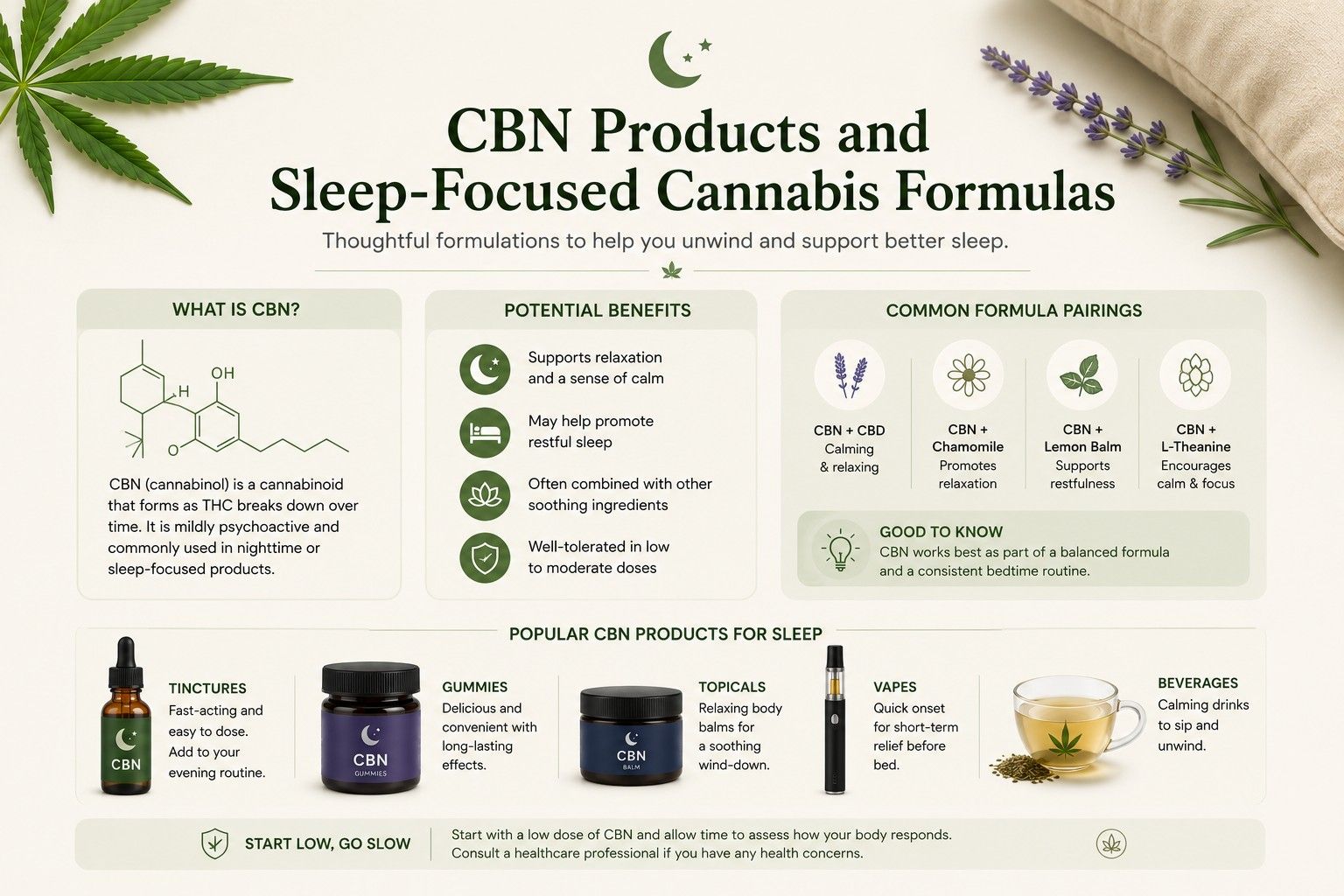
Scroll any dispensary menu at night and you'll probably spot it: a gummy or tincture labeled "nighttime," "wind down," or "sleep," often featuring CBN as the star ingredient. It's become one of the most heavily marketed minor cannabinoids — but what does the research actually say about it?
This guide breaks down what CBN is, how CBN for sleep claims hold up against current science, how cannabis and sleep intersect more broadly, and where CBN fits among other minor cannabinoids showing up on menus.
CBN Explained
CBN isn't grown by the plant the way THC or CBD are — it's more of a byproduct of time and exposure.
What CBN Explained Means and Why It Matters
CBN (cannabinol) primarily forms when THC breaks down over time through exposure to heat, light, and air — it's often described as an "aged" cannabinoid rather than one the plant produces in large amounts on its own
CBN is mildly psychoactive, generally considered less intoxicating than THC at comparable doses
Because it forms from THC degradation, older or improperly stored flower can naturally contain more CBN than fresher product — though this isn't a reliable way to intentionally produce it
Most CBN gummies and tinctures on shelves today use isolated or concentrated CBN added deliberately, rather than relying on natural degradation
What to Look For or Ask About in Store or on the Menu
Check whether a product lists CBN milligrams specifically, not just "contains CBN" without a dose
Ask your budtender whether a CBN product is CBN-dominant or a smaller addition to a broader cannabinoid blend
If a nighttime product also contains THC, check that ratio too — many sleep-marketed formulas combine the two deliberately
Cannabis and Sleep
CBN gets most of the spotlight, but it's rarely the only factor at play in how cannabis products are formulated for nighttime use.
What Cannabis and Sleep Means and Why It Matters
CBN for sleep is a popular marketing angle, but current human research on CBN specifically is limited — much of what's circulated publicly is based on early studies, anecdotal reports, or research on cannabis more broadly rather than CBN in isolation
The most notable recent evidence comes from a University of Sydney study finding that cannabinol increases both non-rapid eye movement and REM sleep in rats, leading to more total sleep time, with an effect comparable to the sleep medication zolpidem. It's an important finding, but it's worth being precise: the results are currently limited to rats, and researchers note further study is needed to see if this translates to humans
Sleep cannabis products often combine CBN with other cannabinoids and terpenes — like myrcene, which is associated with a heavier, more sedating aroma — rather than relying on CBN alone
CBN THC sleep formulas typically pair a modest THC dose with CBN, based on the idea that the combination may feel different than either compound alone, though individual response varies significantly
It's worth being direct here: CBN is marketed for sleep and has been studied for sleep-related effects, but it isn't a proven treatment for insomnia or any sleep disorder
What to Look For or Ask About in Store or on the Menu
Look at the full formulation of a nighttime edible or tincture, not just the CBN callout on the front of the package
Ask your budtender whether a product is CBN-only or a blended cannabinoid formula, since blends are far more common than CBN in isolation
If sleep is a persistent concern for you, that's a conversation for a healthcare provider — not a dispensary label
Minor Cannabinoids Guide
CBN is one of several minor cannabinoids that have moved from lab footnotes to front-of-package marketing in the last few years.
What Minor Cannabinoids Guide Means and Why It Matters
Alongside CBN, you'll commonly see CBG, CBC, and THCV marketed with their own distinct associations — CBN leans nighttime, while others lean daytime or functional
CBN vs CBD is a common point of confusion: CBD is a plant-derived cannabinoid with its own separate profile and is not associated with sedating effects the way CBN is marketed to be, despite the similar name
Because minor cannabinoids occur in small amounts naturally, most CBN products rely on concentrated extraction to reach a consistent, labeled dose
If you want the full landscape of cannabinoids beyond THC and CBD, our guide to CBD, CBG, CBC, CBN, and THCV breaks each one down individually
What to Look For or Ask About in Store or on the Menu
Don't assume "CBN" and "CBD" behave the same way just because the names look similar — ask your budtender to clarify if you're unsure
Compare terpene content alongside cannabinoids — terpenes and THC percentage covers why potency numbers alone don't capture the full picture
If you're specifically interested in the raw, non-intoxicating precursor compound rather than CBN, that's a different cannabinoid entirely — see THCA explained clearly for that distinction
Frequently Asked Questions
What Is CBN?
CBN (cannabinol) is a cannabinoid that primarily forms as THC breaks down over time through exposure to heat, light, and air. It's mildly psychoactive and is commonly marketed in nighttime or sleep-focused cannabis products.
How Does CBN Compare to CBN for Sleep Claims Specifically?
CBN itself is a cannabinoid; "CBN for sleep" refers to the marketing and formulation trend built around it. CBN is marketed for sleep and has been studied for sleep-related effects, but current research is still limited and it isn't an established or approved treatment for insomnia.
What Does "CBN THC Sleep" Mean?
It refers to nighttime cannabis formulas that combine CBN with a modest dose of THC, based on the idea that the combination may feel different than either compound alone. Individual response varies, and this pairing isn't backed by extensive human research yet.
Where Can I Find CBN Products Near Los Angeles?
REBUD weed delivery and dispensary carries a range of CBN-inclusive gummies, tinctures, and nighttime formulas across our shop menu. Browse our current selection or ask a REBUD team member which CBN product fits what you're looking to try.
Is There Any Real Human Research on CBN and Sleep?
Yes — a 2024 double-blind, placebo-controlled study found that a 20mg CBN dose was associated with fewer nighttime awakenings compared to placebo, without added next-day fatigue. It's a meaningful data point, but still early-stage, and it doesn't make CBN an approved sleep treatment.
Does the Dose on the Label Actually Matter for CBN Products?
It can matter quite a bit. A research review found that many commercial CBN products use doses of 5mg or less, well below the amounts studied in the research showing measurable sleep effects. A low CBN dose on a label doesn't necessarily mean it was formulated to match what's actually been studied.
Why Is CBN Suddenly on So Many Menus?
Market data shows CBN's share of California's edible category grew substantially over the past several years, tracking rising consumer interest in cannabinoid-based sleep products generally — separate from any specific claim about how well it works for a given person.
Is It Safe to Combine CBN Products With Prescription Sleep Medication?
This hasn't been specifically studied, so it's not something to assume is fine. If you take a prescription sleep aid, check with your doctor before adding a CBN product to the mix.