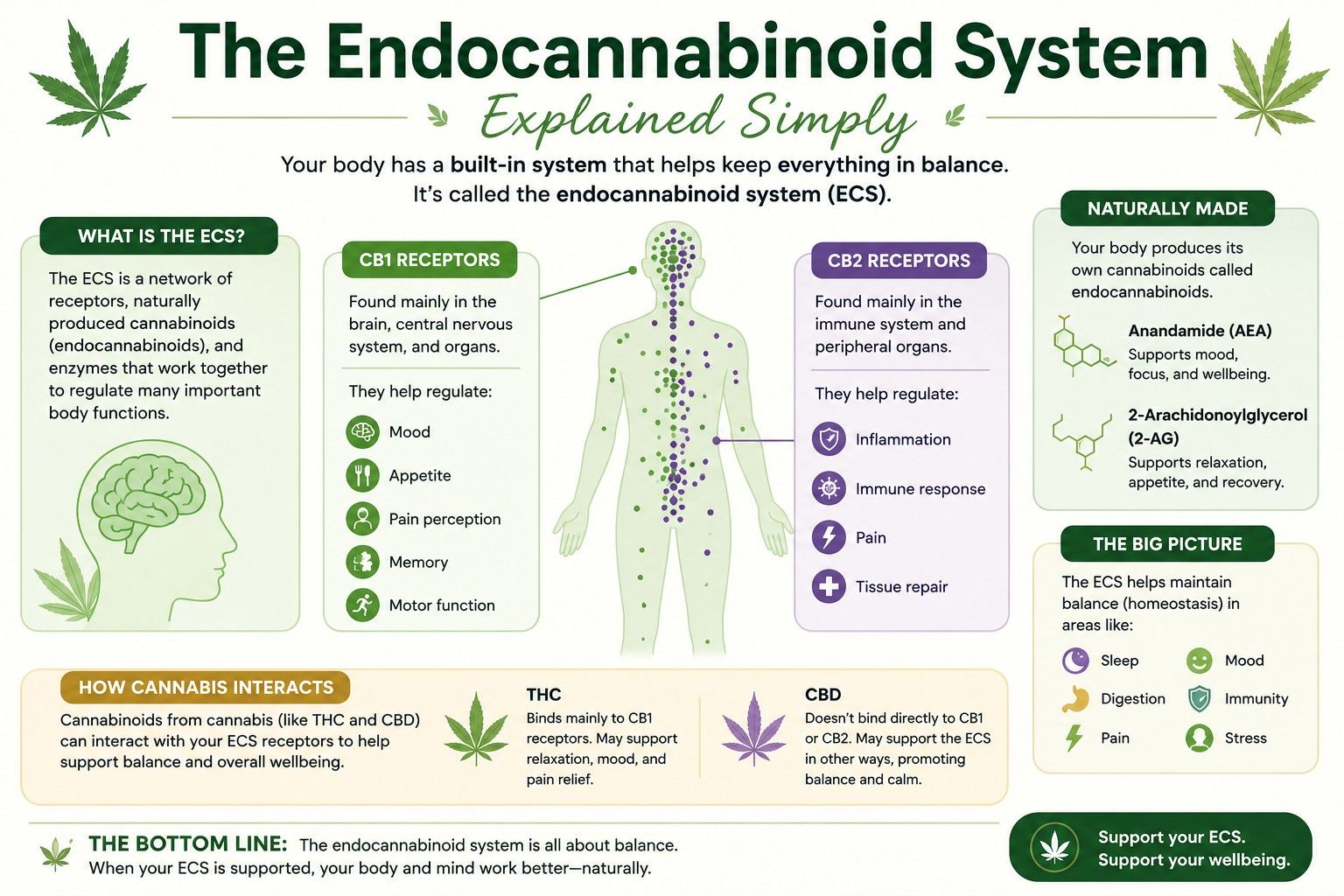
If you've ever wondered why THC produces a noticeable effect while other cannabinoids don't work quite the same way, the answer lives in a body system most people have never heard of: the endocannabinoid system, or ECS.
This guide breaks down what the ECS actually is, how CB1 receptors and CB2 receptors differ, why THC interacts with the body the way it does, and how CBD's relationship with the ECS is different from THC's. Understanding this system is genuinely useful — it's the foundation behind almost every other cannabis science topic, from tolerance to cannabinoid comparisons to why edibles and flower can feel different.
What the Endocannabinoid System Actually Is
Before diving into receptor types, it helps to understand the ECS as a whole system rather than a single mechanism.
The endocannabinoid system is a signaling network found throughout the human body, involved in regulating things like mood, appetite, sleep, and pain sensitivity at a basic physiological level
It's made up of three main parts: cannabinoid receptors (CB1 and CB2), endocannabinoids the body produces naturally (like anandamide and 2-AG), and enzymes that build and break down those compounds
The ECS isn't something cannabis "activates" from nothing — it's a system your body already has and uses constantly, with or without cannabis involved
Plant-derived cannabinoids, like THC and CBD, interact with this existing system in different ways, which is the basis for how cannabis works at a biological level
CB1 vs CB2
The two main receptor types in the ECS behave quite differently, and that difference explains a lot about why various cannabinoids produce different experiences.
Where Each Receptor Type Is Found and What It Does
CB1 receptors are concentrated primarily in the brain and central nervous system, and they're the main receptor type responsible for the psychoactive effects associated with THC
CB2 receptors are found more throughout the peripheral nervous system and immune system, and they generally aren't associated with intoxicating effects
This distribution difference is a major reason THC (which binds strongly to CB1) produces a noticeably different experience than cannabinoids that interact more with CB2 or don't bind as strongly to either receptor
Most cannabinoids interact with both receptor types to varying degrees — it's rarely an all-or-nothing relationship with just one
What to Look For or Ask About in Store or on the Menu
If a product markets itself around a specific cannabinoid, ask your budtender whether it's more CB1- or CB2-associated, since that hints at what kind of experience to expect
Look at a product's full cannabinoid profile, not just its dominant one — minor cannabinoids can shift how the CB1/CB2 interaction plays out overall
If you want to go deeper on cannabinoid structure, our trichomes guide covers where cannabinoids are actually produced in the plant before they ever reach a receptor
Why THC Feels Psychoactive
THC's relationship with CB1 receptors is the core reason it produces effects that other cannabinoids generally don't.
How THC Interacts with CB1 Receptors
THC closely resembles anandamide, one of the body's naturally occurring endocannabinoids, which allows it to bind effectively to CB1 receptors
Because CB1 receptors are so concentrated in the brain, THC's strong binding there is the primary mechanism behind its psychoactive, intoxicating effects
THC binds more directly and with greater intensity to CB1 than the body's natural endocannabinoids typically do, which is part of why its effects can feel more pronounced
This CB1 interaction is also central to why THC content — not just total cannabinoid content — is such a commonly referenced number on labels and menus
What to Look For or Ask About in Store or on the Menu
If potency and CB1-driven effects are your main concern, check calculated THC percentage specifically, not just total cannabinoid content
Ask about a product's terpene profile alongside THC — the combination is often what shapes the fuller experience, not THC alone
Cultivation method can influence cannabinoid concentration too — see our guide to indoor, greenhouse, mixed-light, and sungrown cannabis for how growing conditions factor in
CBD and the ECS
CBD is often discussed in the same breath as THC, but its relationship with the ECS is fundamentally different.
Why CBD's Interaction Is Different from THC's
Unlike THC, CBD doesn't bind strongly or directly to CB1 or CB2 receptors, which is a major reason it's not associated with intoxicating effects the way THC is
Some research suggests CBD may influence the ECS indirectly — for example, by affecting how quickly the body breaks down naturally occurring anandamide — though this area of research is still developing
Because of this different mechanism, CBD-forward products tend to be marketed around a different kind of experience than THC-forward products, even when both come from the same plant
This is also why "cannabinoids" isn't a single category with one shared effect — each one interacts with the ECS differently, which is the basis for a lot of the functional-product marketing you'll see on menus
What to Look For or Ask About in Store or on the Menu
If you're comparing CBD and THC products, remember they interact with the ECS differently — don't assume they'll feel similar just because both come from cannabis
Ask your budtender about CBD:THC ratios if you're looking for a specific balance between the two
If you're curious about the tolerance side of this system — how repeated THC and CB1 interaction can shift over time — that's covered in our cannabis tolerance and tolerance breaks guide
Frequently Asked Questions
What Is the Endocannabinoid System?
The endocannabinoid system (ECS) is a signaling network in the body made up of receptors, naturally produced endocannabinoids like anandamide and 2-AG, and the enzymes that regulate them. It plays a role in regulating functions like mood, appetite, sleep, and pain sensitivity, and it's the system cannabinoids like THC and CBD interact with.
What Is the Difference Between CB1 and CB2 Receptors?
CB1 receptors are concentrated mainly in the brain and central nervous system and are primarily responsible for THC's psychoactive effects. CB2 receptors are found more throughout the immune system and peripheral tissues and generally aren't associated with intoxicating effects.
What Is Anandamide?
Anandamide is one of the body's naturally occurring endocannabinoids, sometimes nicknamed the "bliss molecule." It's structurally similar to THC, which is part of why THC is able to bind effectively to the same CB1 receptors anandamide normally interacts with.
Where Can I Learn More About How Cannabis Works Near Los Angeles?
REBUD's team can walk you through how different cannabinoids interact with the ECS and help match that to products on our LA menu. For more foundational science topics, our Cannabis Academy glossary is also a good starting point.