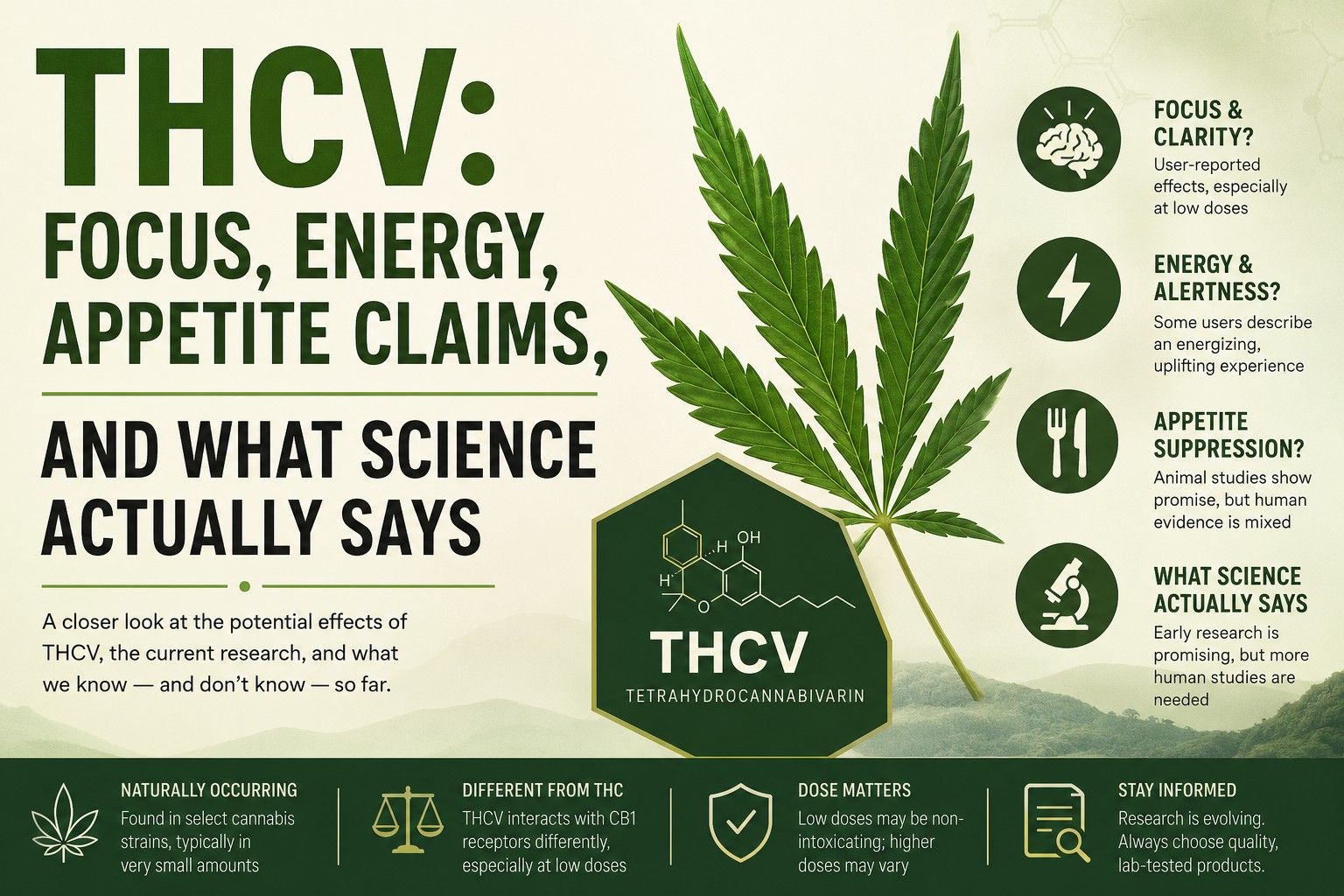
If you've noticed THCV showing up on more labels lately — often paired with words like "energy," "focus," or "appetite control" — you're not imagining the trend. It's one of the fastest-growing minor cannabinoids on dispensary menus, and also one of the most overhyped.
This guide breaks down what THCV actually is, how it compares to THC, what the research does and doesn't currently support about focus, energy, and appetite, and how to read those marketing claims with a more critical eye before you buy.
THCV Explained
THCV is chemically similar to THC, but a small structural difference changes how it behaves in the body — especially at lower doses.
What THCV Explained Means and Why It Matters
THCV (tetrahydrocannabivarin) is a cannabinoid naturally found in cannabis, structurally similar to THC but with a shorter side chain
At low doses, THCV is generally considered non-intoxicating and may even act as a CB1 receptor antagonist — meaning it can behave almost oppositely to THC in some respects
At higher doses, THCV can become mildly psychoactive, though effects are typically described as shorter and less intense than standard THC
Much of what's said about THCV's effects comes from user-reported experience and early-stage research rather than large-scale human clinical trials — research here is still developing.
What to Look For or Ask About in Store or on the Menu
Check whether a product lists THCV milligrams specifically, not just "contains THCV" without a dose
Ask your budtender whether the product is THCV-dominant or a small addition to a THC-forward formula — the ratio matters
If a listing makes strong before/after promises, treat it skeptically — dosing and individual response vary considerably
Minor Cannabinoids Guide
THCV is part of a broader group of cannabinoids that show up in smaller concentrations than THC or CBD but are getting more attention as testing and product formulation improve.
What Minor Cannabinoids Guide Means and Why It Matters
Minor cannabinoids include compounds like CBG, CBN, CBC, and THCV — each with a distinct chemical profile and different anecdotal associations
THCV is often grouped with "daytime" or "energizing" formulations, while compounds like CBN are more commonly marketed toward evening or wind-down use
Because these cannabinoids occur in smaller amounts naturally, many THCV products use concentrated extracts to reach a noticeable dose
If you want the fuller landscape of cannabinoids beyond THC and CBD, our guide to CBD, CBG, CBC, CBN, and THCV breaks each one down individually
What to Look For or Ask About in Store or on the Menu
Ask whether a "minor cannabinoid" blend uses isolated extracts or naturally occurring ratios from the plant
Compare terpene content too — terpenes and THC percentage covers why potency numbers alone don't tell the whole story
If you're specifically curious about the raw, non-intoxicating precursor compound rather than THCV, that's a different cannabinoid — see THCA explained clearly for that distinction
Functional Cannabis Claims to Treat Carefully
THCV marketing has moved fast, and some of it has outpaced what current research actually supports — especially around appetite and weight.
What Functional Cannabis Claims to Treat Carefully Means and Why It Matters
You'll often see THCV appetite claims framed as appetite suppression, sometimes marketed alongside weight-management language — this is an area of early, ongoing research, not an established or approved outcome
THCV energy and THCV focus claims are largely based on user-reported experience; some small studies have explored motivation, focus, and energy self-reporting, but findings are preliminary and not a guarantee of individual results
No cannabinoid product, including THCV, is an approved treatment for weight loss, diabetes, or any medical condition — claims suggesting otherwise should be treated with skepticism
"Functional cannabis" framing (energy, focus, calm, etc.) can be a genuinely useful way to think about product selection, as long as it's understood as reported experience rather than a guaranteed or medical effect
What to Look For or Ask About in Store or on the Menu
Be cautious of any product claiming guaranteed weight loss, appetite elimination, or medical benefit — that's a marketing red flag, not a research-backed claim
Ask your budtender what's actually known about a specific THCV product's formulation and dose, rather than relying on packaging claims alone
If you're managing a health condition, that's a conversation for a doctor — not a dispensary label
Frequently Asked Questions
How Does THCV Compare to THC?
THCV and THC share a similar structure but behave differently, especially at lower doses. THC is more consistently associated with intoxicating effects and appetite stimulation, while THCV at low doses may act more like a CB1 antagonist — sometimes described as producing a clearer, more energizing experience, based largely on user reports and early research.
What Does THCV Focus Mean?
"THCV focus" refers to user-reported experiences of alertness and mental clarity associated with THCV use, particularly at lower doses. It's not a guaranteed or clinically established effect — individual response varies, and research in this area is still developing.
Where Does THCV Actually Come From?
THCV occurs naturally in cannabis, but usually in very small amounts. It's more concentrated in certain sativa-leaning genetics with African landrace origins, like Durban Poison, along with some purpose-bred cultivars — which is part of why THCV products have historically been harder to source and more expensive than THC-dominant ones.
Does the Research Actually Support THCV as an Appetite Suppressant?
It's mixed. Animal studies have suggested THCV may reduce food intake, but the most notable human trial — a 13-week study in people with type 2 diabetes — found no measurable effect on appetite or body weight, even though it showed other metabolic changes. In short: promising in early research, but not yet confirmed in humans specifically for appetite.
Are There Any Known Side Effects of THCV?
Reported human studies (generally up to 10mg daily) haven't flagged major side effects, though some participants reported feeling more tired than usual. As with any cannabinoid, avoid driving until you know how it affects you — especially if combined with THC.
Is THCV in Cannabis Products the Same as Hemp-Derived THCV?
Not necessarily a given. REBUD's THCV products come from licensed, cannabis-derived sources regulated under California's cannabis program.
Where Can I Find THCV Near Los Angeles?
REBUD carries a range of THCV-inclusive products across our menu, including flower, vapes, and blended formulations. Browse our current selection or ask a REBUD team member which THCV product fits what you're curious to try.