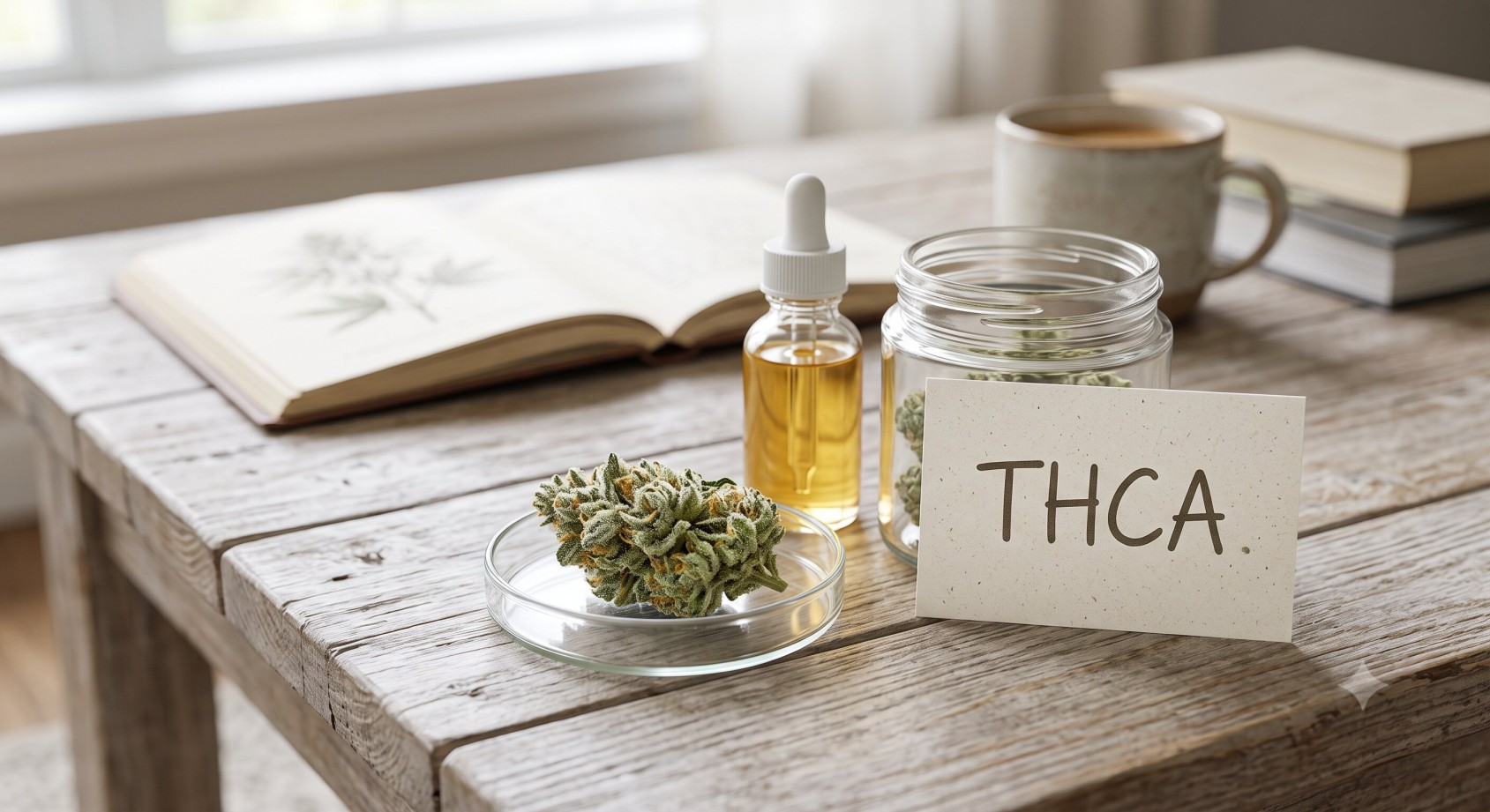
If you've been browsing weed products at a dispensary or scrolling through an online menu, you've probably spotted "THCA" on the label and wondered what it actually means. You're not alone — LA consumers ask about this constantly, and it's one of the most misread numbers on any cannabis package. Understanding what is THCA — and how it differs from the THC percentage you might already know — changes how you shop. This guide covers the core science in plain language, explains decarboxylation, and shows you exactly how to decode a cannabis label before you buy.
THCA vs THC
THCA and THC are related compounds, but they behave very differently in the body. Knowing the distinction is the single most useful thing you can do before reading any cannabis label — and it's simpler than it sounds.
The Chemical and Practical Difference
THCA (tetrahydrocannabinolic acid) is the raw, acidic form of THC found naturally in the cannabis plant while it's still growing and freshly harvested. In that unactivated state, THCA is non-intoxicating — it cannot produce a psychoactive effect on its own because it doesn't bind efficiently to the CB1 receptors in your brain and central nervous system. THC (delta-9-tetrahydrocannabinol) is what THCA becomes once heat is applied. That transformation — called decarboxylation — is what makes cannabis psychoactively active. According to the National Institute on Drug Abuse, delta-9-THC is the primary compound responsible for the intoxicating effects associated with cannabis use.
For consumers exploring the broader landscape of Cannabinoids Beyond THC — including CBD, CBN, CBG, and THCV — it helps to know that THCA is just one of many acidic precursor compounds present in the raw plant. Each has its own conversion pathway and potential effects profile.
What to Look For or Ask About in Store or on the Menu
When browsing the Rebud menu in-store or online, you'll see THCA listed as a percentage on flower products. That number reflects potential potency, not current THC content. A quick question to ask a budtender: "What's the THCA percentage, and what's the estimated total THC after decarboxylation?" As a general benchmark: higher THCA% on flower almost always means stronger effects once smoked or vaporized.
What Decarboxylation Means
Decarboxylation sounds technical, but it describes something that happens automatically every time you light a joint, load a bowl, or hit a vaporizer. Once you understand the process, every label you read will make more sense.
How Heat Converts THCA into THC
When cannabis is exposed to heat — through smoking, vaping, or oven-baking — a carboxyl group (COOH) is removed from the THCA molecule. What remains is delta-9-THC. This chemical reaction is decarboxylation, and it's the reason raw cannabis consumed without heat has a fundamentally different effect profile than smoked or vaporized flower. A research has documented the temperature-dependent kinetics of this conversion, confirming that efficient decarboxylation requires sustained heat above 104°C (220°F). Even edibles go through this process: cannabis is decarboxylated in an oven before it's infused into butter, oil, or a finished product.
For a comprehensive look at how cannabinoid science informs product formulation — including the role of heat in terpene preservation — the New Phytologist Foundation provides accessible summaries of current findings.
What to Look For or Ask About in Store or on the Menu
If you're buying THCA flower or any product where heat will be applied (joints, bowls, vapes), focus on the THCA percentage as your primary potency indicator. For pre-made edibles and extracts, the THC milligram count is already listed post-decarboxylation — no conversion needed. When in doubt, the staff at Rebud can explain exactly what each number means for the specific weed products you're considering.
How to Read THCA on a Label
California requires every licensed cannabis product to display full cannabinoid content — including THCA — on its packaging. Under California Department of Cannabis Control regulations, this panel must be tested by a licensed lab and accurately reflect the product inside. But the numbers only tell you something useful if you know how to read them.
What the Percentage Actually Tells You
The THCA percentage on a flower label shows how much of the raw flower's weight is THCA by mass. To estimate total THC after smoking, use this formula:
Total THC = (THCA × 0.877) + Δ9-THC
A flower testing at 24% THCA would yield roughly 21% THC after full decarboxylation — an already potent result. This is why the conversation around Terpenes vs. THC Percentage matters so much among experienced consumers. THCA alone doesn't tell you how a product will feel. Terpenes like myrcene, limonene, and caryophyllene interact with cannabinoids to shape the overall experience — a concept often called the entourage effect. High THCA with a rich terpene profile will feel different from a high-THCA product with a sparse one.
For new consumers who want to build vocabulary around these terms, the Cannabis Academy glossary is a useful starting point for understanding terms like THCA, terpenes, and cannabinoid ratios before you walk into a dispensary.
What to Look For or Ask About in Store or on the Menu
Don't stop at the THCA number. Look for the full cannabinoid panel. A product listing both THCA and CBD, or THCA alongside notable terpene content, gives you a more complete picture. For instance:
High THCA + low CBD → typically a stronger, more psychoactive experience
High THCA + moderate CBD → often described as more balanced
High THCA + CBN → products formulated with CBN are sometimes marketed for their effect on sleep, though individual responses vary
When in doubt, ask a Rebud budtender to walk you through the panel. That's what they're there for.
FAQ
What Is THCA?
THCA (tetrahydrocannabinolic acid) is the raw, non-intoxicating precursor to THC found in freshly harvested cannabis. It converts to THC when exposed to heat through smoking, vaping, or cooking. In its raw acidic form, THCA does not produce a psychoactive effect because it doesn't bind efficiently to the CB1 receptors that THC activates.
How Does THCA Compare to THC?
THCA is the acidic, inactive form of THC present in raw cannabis before decarboxylation. It doesn't bind to the same receptors in the brain the way THC does. Once heat is applied, THCA loses its carboxyl group and becomes delta-9-THC — the compound associated with intoxication. The THCA percentage on a label represents potential potency, not current THC content. Always apply the formula Total THC = (THCA × 0.877) + Δ9-THC to estimate the actual potency of a flower product.
What Does Decarboxylation Mean?
Decarboxylation is the heat-driven chemical process that converts THCA into THC by removing a carboxyl group from the molecule. It happens automatically when you smoke or vape cannabis. It also occurs when cannabis is prepared for edibles — usually by heating in an oven at around 220–245°F before infusion. Without decarboxylation, THCA remains in its acidic form and does not produce intoxicating effects.
Where Can I Find THCA Products Near Me in Los Angeles?
Rebud carries a curated selection of licensed THCA flower, pre-rolls, and vape products across our Los Angeles dispensary locations — including North Hollywood, Highland Park, Sylmar, and Westwood — and delivers across LA County and into Orange County. Browse the full Rebud menu online or visit any location to speak with a budtender about current THCA flower inventory and product recommendations.