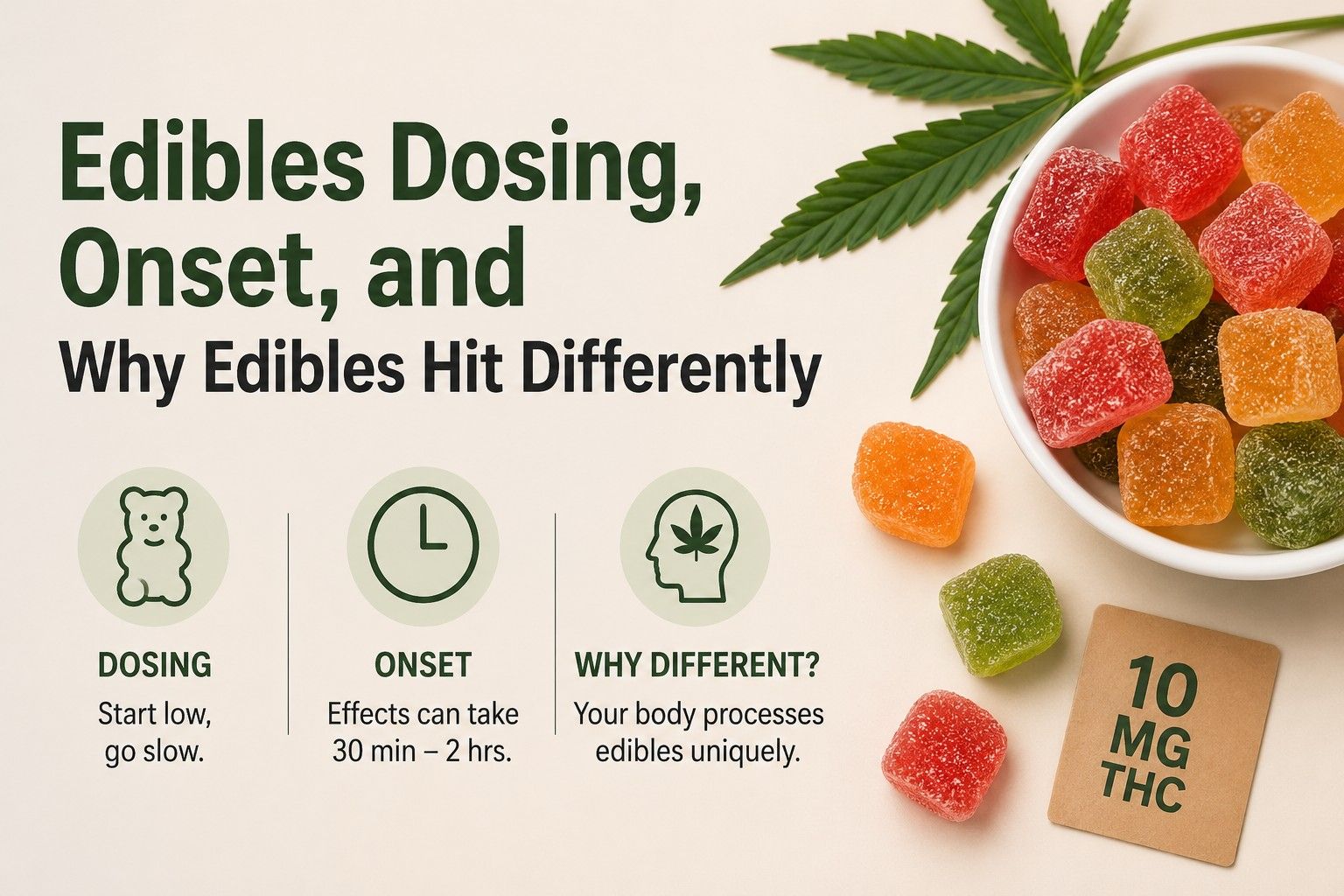
If you've ever eaten a gummy, waited twenty minutes, felt nothing, and eaten a second one — only to feel both kick in at once an hour later — you're not alone. Edible dosing confuses even experienced consumers, and it's one of the most common questions REBUD hears from LA shoppers browsing our menu.
The short version: edibles take longer to work than smoking or vaping, and the effects can feel stronger and last longer once they arrive. The reason comes down to how your body processes THC once it's swallowed versus absorbed another way.
This guide covers how long do edibles take to kick in, why THC drinks and gummies behave differently, how sublingual products compare to traditional edibles, and a practical starting-dose framework for beginners.
THC Drinks vs Gummies
Both are popular, beginner-friendly formats — but they don't work the same way, and knowing the difference helps you plan your order.
Onset and Duration Differences
THC drinks are often formulated with fast-acting or nano-emulsified THC, which can shorten onset to roughly 15–45 minutes for some products.
Gummies and traditional edibles typically take 30–120 minutes to take effect, since they must be digested and processed by the liver first.
Drinks tend to peak sooner and may taper off faster; gummies often build more gradually and can last 4–8 hours depending on dose and individual metabolism.
This delayed, digestion-dependent path is also why edible effects can feel more intense than expected — your body converts THC into 11-hydroxy-THC, a compound that's produced during digestion and is generally considered to produce a stronger, longer-lasting effect than the THC found in inhaled products.
What to Look For or Ask About in Store or on the Menu
Check the label or menu listing for "fast-acting" or "nano" formulations if faster onset is the goal
Ask your budtender about milligram count per serving, not just per package
Look for a lab-tested batch — if the COA numbers don't mean much to you yet, we've got a breakdown of what those lab results actually show.
Sublingual vs Edible
Sublingual products — tinctures, dissolvable strips, and lozenges placed under the tongue — sit between inhalables and traditional edibles in terms of speed.
Why Absorption Method Changes Onset Time
A sublingual tincture is absorbed partly through the tissue under the tongue and partly swallowed, so onset can land around 15–45 minutes — faster than most gummies
Because a portion bypasses full digestion, sublingual use may produce less 11-hydroxy-THC conversion than a fully digested edible, which can mean a somewhat different effect profile
Traditional edibles rely entirely on digestion, so timing is more dependent on your last meal, metabolism, and stomach contents
What to Look For or Ask About in Store or on the Menu
Ask whether a tincture is meant to be held under the tongue for absorption or swallowed directly — instructions vary by brand
If you're shopping by the experience you want rather than just format, functional cannabis and shopping by desired experience covers options beyond just "edible" or "flower"
Compare milligrams per dropper or strip so you can measure consistently
Beginner Edible Dosing Guide
Start low, go slow. It's the most repeated phrase in cannabis retail for a reason — edibles are easy to underestimate before onset and easy to overdo once it arrives.
Practical Starting Doses and Dose-Splitting
New consumers: consider starting around 2.5–5mg THC per dose
Occasional consumers: 5–10mg is a common starting range
Dose-splitting example: if a gummy contains 10mg, cut it in half and take 5mg first. Wait at least 2 hours before considering more.
Avoid stacking doses just because you don't feel anything in the first 30–45 minutes — this is the most common reason edibles feel unexpectedly strong
If you want to keep exploring low doses over time rather than one-off servings, low-dose cannabis and microdosing walks through that strategy in more depth
What to Look For or Ask About in Store or on the Menu
Ask if a product is scored or pre-portioned for easy dose-splitting
Look for per-piece milligram labeling, not just total package strength