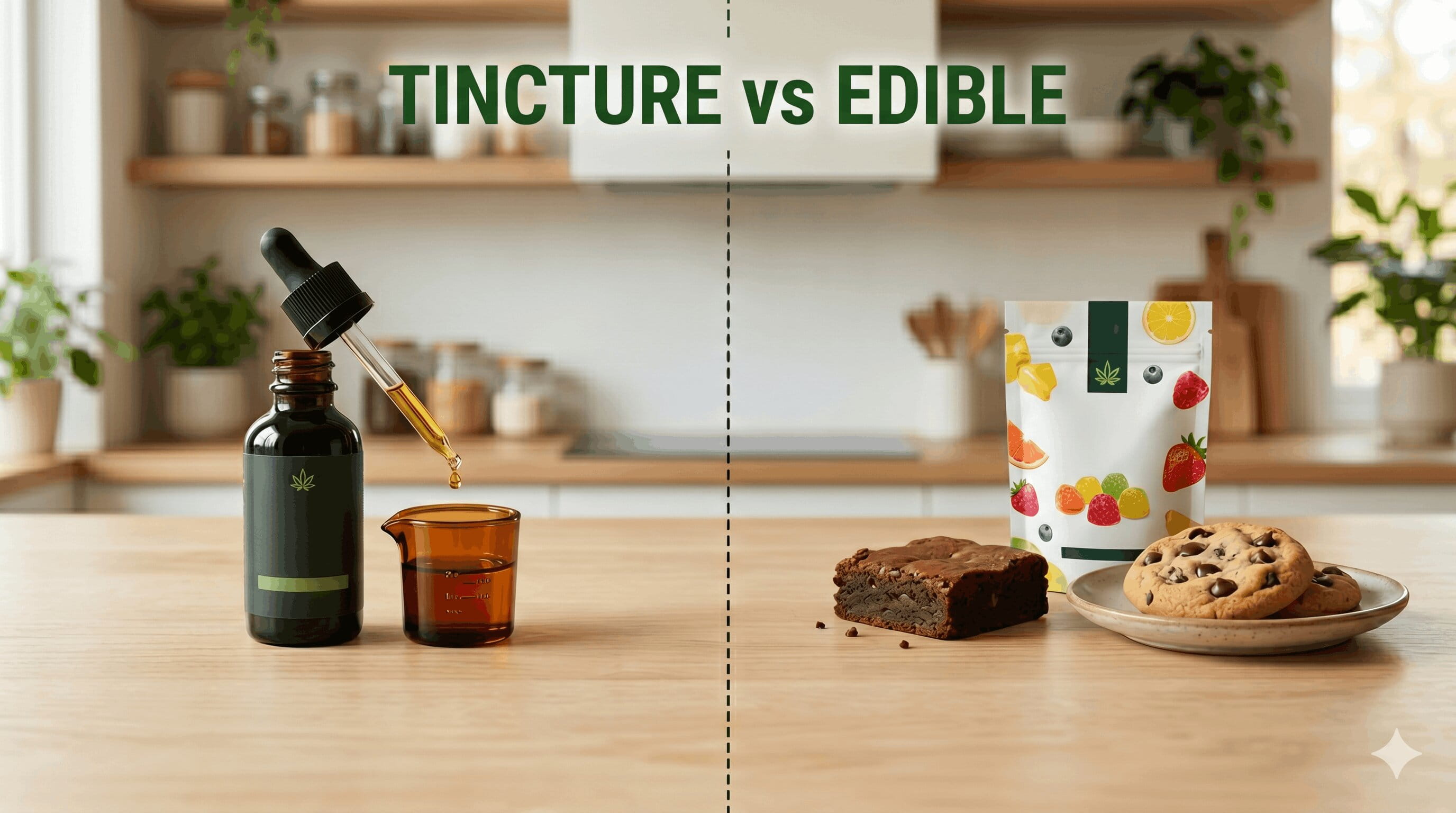
Tinctures and edibles are two of the most popular smoke-free cannabis products on dispensary shelves today. Both deliver cannabinoids without combustion, both come in a wide range of formulations, and both offer a level of discretion that inhalation methods simply cannot match.
But despite those similarities, a tincture vs edible comparison reveals some meaningful differences that can shape your experience and how you integrate cannabis into your daily routine.
The key distinctions come down to format, how each product is consumed, how quickly effects are typically felt, and how easy each one is to dose and carry. Neither option is inherently better than the other. The right choice depends entirely on your preferences, lifestyle, and what you are looking for in a cannabis product.
What Is a Cannabis Tincture?
A cannabis tincture is a liquid cannabis extract, typically packaged in a small glass bottle with a dropper cap. The dropper allows users to measure out precise amounts, making tinctures one of the more adjustable formats available at a dispensary.
Most tinctures are made by infusing cannabis extract into a carrier liquid, commonly MCT oil, hemp seed oil, or a similar food-grade oil. The result is a concentrated liquid that can be used in a few different ways.
The most common method is sublingual use, where a few drops are placed under the tongue and held for a short period before swallowing. This allows cannabinoids to be absorbed directly through the mucous membranes in the mouth. Tinctures can also be added to food and drinks, though this changes how the body processes them, bringing the experience closer to that of an edible.
Tinctures are available in a wide variety of cannabinoid formulations, including THC-dominant, CBD-dominant, and balanced THC: CBD ratios. Some products also feature specific terpene profiles or minor cannabinoids. Flavored options exist alongside more neutral, natural cannabis-tasting formulas, giving consumers choices that align with their taste preferences.
What Is a Cannabis Edible?
A cannabis edible is any food or beverage product infused with cannabis extract. The category is broad and includes gummies, chocolates, mints, cookies, hard candies, crackers, and a growing lineup of cannabis-infused beverages including sparkling waters, teas, and shots.
Edibles are consumed like any other food or drink. There is no measuring, no dropper, and no sublingual hold required. Each piece or serving contains a pre-measured amount of cannabinoids, printed on the label, which makes them straightforward for consumers who want a consistent, no-fuss serving each time.
The edibles category has expanded significantly in recent years. Beyond the standard gummy, consumers can now find infused chocolates with single-origin cacao, seasonally released flavors, beverage alternatives designed for social settings, and micro-dosed mints for those who prefer a lighter serving. Licensed dispensaries like Rebud carry a curated selection spanning multiple brands, formats, and potency levels.
Edibles are widely favored among consumers seeking a discreet option. They look and consume like ordinary food, making them easy to use in situations where more obvious consumption methods would stand out.
Tincture vs Edible: Quick Comparison
Here is a side-by-side breakdown of the most important differences between cannabis tinctures and edibles:
Key Differences Between Tinctures and Edibles
While tinctures and edibles are both popular smoke-free cannabis consumption methods, they differ in several important ways. Understanding the key differences in this cannabis tincture vs edible comparison can help you choose the format that best fits your lifestyle and routine.
Format and Consumption Method
The most obvious difference between a tincture vs edible is the format. Tinctures are liquids housed in small dropper bottles. Edibles are food products. This means the consumption experience is fundamentally different: one involves placing drops under your tongue or stirring a liquid into a drink, while the other involves eating or drinking something that looks and tastes like a regular snack or beverage.
Dosing Style
Tinctures are designed for drop-by-drop control. The dropper allows you to start with a small amount and increase gradually, which is useful for consumers who want flexibility. Edibles come pre-portioned. Each gummy, piece of chocolate, or mint contains a fixed amount of cannabinoids, so the dosing decision is made at the product level rather than at the point of consumption.
Flavor Options
Tinctures range from naturally cannabis-flavored to lightly sweetened or flavored with mint, citrus, or berry. The flavor profile is generally subtle. Edibles offer a much wider flavor landscape, from classic fruit gummy flavors to single-origin chocolate, sour coatings, cooling mint, and seasonal varieties. For consumers who strongly prefer or strongly dislike the taste of cannabis, this is often a meaningful factor.
Product Versatility
Tinctures have a built-in versatility advantage: they can be used sublingually, stirred into coffee or juice, or blended into a smoothie. This makes them adaptable to different routines and preferences. Edibles are more fixed in their format. A gummy is a gummy. While you can pair it with food or drink, the product itself is not designed to be mixed or modified.
Convenience and Storage
Both formats are convenient in their own ways. Tinctures are compact and take up minimal space, but the liquid format requires care to prevent spills or leaks in transit. Edibles in individually wrapped pieces or sealed pouches are grab-and-go friendly, though gummies and chocolates can be temperature-sensitive. Tinctures generally have a longer shelf life when stored away from heat and light, while edible shelf lives vary by product type.
Onset Time and Duration
Onset time and duration are two of the most commonly asked-about differences in a tincture vs edible comparison. Both can vary considerably depending on several factors, and it is worth understanding what influences each.
For tinctures used sublingually, cannabinoids are absorbed directly through the tissues under the tongue, which generally produces a faster onset compared to products that must pass through the digestive system. When a tincture is added to food or a drink instead, it is processed more like an edible, and the onset timeline shifts accordingly.
Edibles are digested and processed through the gastrointestinal system, which means the onset is typically slower than sublingual use. How quickly you feel effects from an edible can depend on some personal and situational factors:
Whether you have eaten recently and the contents of your stomach
Your individual metabolism and body chemistry
The specific product formulation and type of infusion
The serving size consumed
Duration also varies. Sublingual tincture use often produces effects for a shorter window than edibles, while edibles metabolized through digestion are frequently associated with a longer-lasting experience. That said, individual variation is significant, and product formulation matters. Reading the label and starting with a smaller serving is always a sound approach, regardless of format.
Dosing and Convenience
Dosing is an area where tinctures and edibles take genuinely different approaches, and the right one depends on how much control you want.
Tincture Dosing
Tinctures come with a dropper that typically holds 1 milliliter of liquid. The product label indicates how many milligrams of cannabinoids are in each full dropper or in each specific number of drops. This allows consumers to start with a partial dropper, observe how they feel, and adjust their serving in future sessions with a level of precision that most edibles do not offer.
For beginners especially, this incremental control can be a significant advantage. Rather than committing to a fixed 10mg gummy, a tincture user can start with a 2.5mg or 5mg serving and work their way up over time.
Edible Dosing
Edibles solve the measuring problem in a different way: the serving is already determined. Each piece of a 10-piece gummy pack contains one-tenth of the total cannabinoid content. Each square of a chocolate bar contains a specified amount. This simplicity is genuinely appealing for consumers who find dropper-based measuring inconvenient or unnecessary.
Many edible products are now available in micro-dosed formats, with individual pieces containing as little as 2.5mg of THC. This makes low-dose precision accessible without any measuring on the consumer's part. For those who prefer a specific and consistent serving every time, a pre-portioned edible can be more reliable in day-to-day use.
Flavor and Product Variety
Flavor is a personal matter, and both tinctures and edibles offer enough variety to accommodate a wide range of preferences.
Tinctures
The flavor profile of a cannabis tincture depends largely on its base ingredients. Tinctures made with MCT oil or hemp seed oil have a neutral to mildly earthy taste. Some products incorporate natural flavorings to produce mint, citrus, berry, or vanilla notes that soften the cannabis taste. For consumers who do not want to taste cannabis at all, a flavorless tincture added to a strongly flavored beverage can effectively mask it entirely.
Edibles
Edibles span a far wider flavor spectrum. The category includes:
Gummies in fruit flavors ranging from tropical to sour to classic berry
Chocolates in milk, dark, and white varieties with flavor inclusions like caramel, sea salt, and nuts
Mints in spearmint, peppermint, and cooling hybrid flavors
Cookies, brownies, and rice crispy treats in traditional baked good flavors
Infused beverages including sparkling water, lemonade, iced tea, and energy-style shots
Seasonal and limited-edition products released around holidays and special occasions
The variety in the edibles category has expanded rapidly, driven by consumer demand for products that fit naturally into everyday eating and drinking habits. For someone who finds cannabis products intimidating, a familiar gummy or a piece of chocolate can be a more approachable entry point than a dropper bottle.
Which Is Easier to Travel With?
Portability is a practical consideration that many consumers overlook until they are trying to fit a cannabis product into a bag or carry it somewhere discreetly.
Tinctures on the Go
Tinctures have a compact profile. A standard 30ml dropper bottle fits easily into a purse, jacket pocket, or small bag. The main consideration when traveling with a tincture is preventing leaks. The dropper cap should be fully secured, and storing the bottle upright reduces the chance of oil seeping out. For longer trips or bags that get jostled frequently, placing the tincture in a small zip-lock bag provides extra protection.
Edibles on the Go
Edibles in individually wrapped servings or resealable pouches are among the most portable cannabis products available. There is no risk of spilling, no dropper to manage, and no preparation required. The main considerations are temperature sensitivity and format. Gummies can melt or stick together in heat. Chocolates are especially susceptible to warm weather, which can compromise their texture. Hard candies and mints tend to travel the best, as they are less affected by temperature fluctuations.
Discreet Consumption
Both tinctures and edibles score well on discretion. A dropper bottle blends in as a supplement or wellness product to most observers. Eating a gummy or mint looks indistinguishable from consuming regular candy. Neither format produces smoke or vapor, making both suitable for situations where inhalation would not be appropriate.
Note that regardless of format, California cannabis products should only be transported and consumed in accordance with state law. Always keep products in their original, labeled packaging and do not consume cannabis while driving.
How to Choose Between a Tincture and an Edible
The best way to approach this decision is to think about your routine, your preferences, and what you want from a cannabis product. Neither a tincture nor an edible is universally better. They are simply optimized for different preferences and situations.
Many consumers find that both formats have a place in their routine depending on the occasion. A tincture might be the preferred daily option for someone who appreciates flexible dosing, while the same person might reach for a gummy when going out with friends or traveling.
Key Questions to Help You Choose
If you are still unsure which direction to go, a few practical questions can help narrow it down:
What is your experience level? If you are new to cannabis, micro-dosed edibles and low-serving tinctures are both accessible starting points. Edibles offer the simplicity of pre-measured servings, while tinctures offer the flexibility to dial in a serving drop by drop.
What format appeals to you? Some people find the idea of a dropper awkward or clinical; others find edibles too indulgent. Go with the format that fits naturally into how you already live.
How much control do you want over your serving size? If precision and flexibility matter, a tincture is the stronger choice. If consistency and simplicity matter, a pre-portioned edible wins.
Do you have flavor preferences? If you strongly dislike the taste of cannabis, look for a flavored tincture or a flavorful edible that masks it well. If you do not mind the taste, both formats work equally well.
How will you use the product day to day? Consider where you will use it, whether you need it to be portable, and whether you want something you can incorporate into meals and drinks.
What does the label tell you? Always read the label before purchasing. Look for the cannabinoid content per serving, the total number of servings, and any storage instructions. Purchasing from a licensed dispensary ensures that labels are accurate and products are tested.
At Rebud, both tinctures and edibles are available in a range of formulations, potency levels, and flavors across our five Los Angeles dispensary locations and through our delivery service covering LA and Orange County. Our team is happy to walk you through the options and help you find a product that fits your preferences. You can also explore more options and take advantage of additional benefits through Rebud Monthly Membership.
Frequently Asked Questions
What's the Difference Between a Cannabis Tincture and an Edible?
A cannabis tincture is a liquid extract packaged in a dropper bottle, designed to be taken sublingually or added to food and drinks. A cannabis edible is an infused food or beverage, such as a gummy, chocolate, or mint, consumed like ordinary food. The main differences are format, consumption method, and how each product is dosed.
Are THC Tinctures Stronger Than Edibles?
Strength depends on the specific product and the serving size consumed, not the format itself. Both THC tinctures and cannabis edibles are available across a wide range of potency levels, from micro-dosed options to high-potency products. Always check the milligrams of cannabinoids per serving listed on the label rather than assuming one format is stronger than another.
Are Tinctures Easier to Dose Than Edibles?
Cannabis tinctures offer more adjustability because the dropper allows you to measure out a specific number of milligrams. Edibles are pre-portioned, which makes them simpler but less flexible. Whether one is easier depends on what you are looking for: drop-by-drop control with a tincture, or a fixed, no-measuring serving with an edible.
How Do You Use a Cannabis Tincture?
To use a cannabis tincture sublingually, place the measured drops under your tongue using the dropper, hold for 30 to 60 seconds, then swallow. Tinctures can also be stirred into beverages like coffee, juice, or water, or added to foods like yogurt or oatmeal. Keep in mind that when a tincture is ingested through food rather than held under the tongue, it is processed similarly to a cannabis edible, which can affect how quickly effects are felt.
Tincture vs Gummy: Which Is Better?
Neither is universally better — it depends on your priorities. A tincture gives you more dosing control and faster sublingual onset. A gummy is simpler, more flavorful, and requires no measuring. Many consumers use both depending on the situation.
Which Lasts Longer: a Sublingual Tincture or an Edible?
When tinctures are used sublingually, the experience often has a shorter duration than edibles processed through digestion. Cannabis edibles are frequently associated with a longer-lasting experience because of how cannabinoids are metabolized through the digestive system. That said, individual variation is significant, and results can differ meaningfully from person to person.
Are Cannabis Tinctures or Edibles Better for Beginners?
Both are beginner-friendly compared to inhalation cannabis consumption methods. Edibles in low-dose formats are simple and require no measuring. Cannabis tinctures in low-serving formulations allow beginners to start small and adjust gradually. The best option depends on personal comfort with each format. A budtender at any Rebud location can help new consumers identify a good starting product.
Do Cannabis Tinctures Taste Different From Edibles?
Yes, typically. Cannabis tinctures have a more neutral to mildly earthy or herbal flavor, depending on the base oil and any added flavorings. Edibles are formulated to taste like food, with flavors ranging from fruit and chocolate to mint and caramel. Consumers who dislike the taste of cannabis often find flavored edibles or strongly flavored tincture beverages more palatable.
Can I Buy Cannabis Tinctures and Edibles at a Dispensary?
Yes. Licensed dispensaries typically carry a variety of cannabis tinctures and edibles in different formulations, flavors, and serving sizes. Rebud carries a curated selection of both formats across all five of our Los Angeles dispensary locations, and both are available for delivery throughout LA and Orange County.
Do Tinctures Show Up on Drug Tests?
Yes, THC tinctures can show up on a drug test. Most standard drug tests screen for THC metabolites, the compounds your body produces after processing tetrahydrocannabinol (THC). If a tincture contains THC, it will be metabolized the same way as any other cannabis product, and those metabolites can remain detectable in urine, blood, saliva, or hair depending on the test type and your usage frequency.
Conclusion
Tinctures and edibles are both well-established, smoke-free ways to enjoy cannabis, and both have a strong following among consumers who prefer not to inhale. They share the benefit of discretion, convenience, and wide availability at licensed dispensaries. Where they differ is in format, consumption experience, dosing style, and how they fit into different lifestyles.
A cannabis tincture offers drop-by-drop flexibility and the option to use it sublingually or mix it into food and drinks. A cannabis edible offers a familiar, food-based format with pre-measured servings and an expansive variety of flavors and product types.
Choosing between tinctures and edibles is less about which one is better and more about which one suits you. Understanding how each format works gives you the foundation to make a confident, informed decision at the dispensary counter or when shopping online.
Ready to explore your options? Browse Rebud's tincture and edible collection online or stop into any of our Los Angeles locations to see the full selection in person. Our team is here to help you find the right product for your preferences.
This guide covers everything you need to know about cannabis tinctures and cannabis edibles, including how each one works, how they compare side by side, and how to decide which format is the best fit for you.