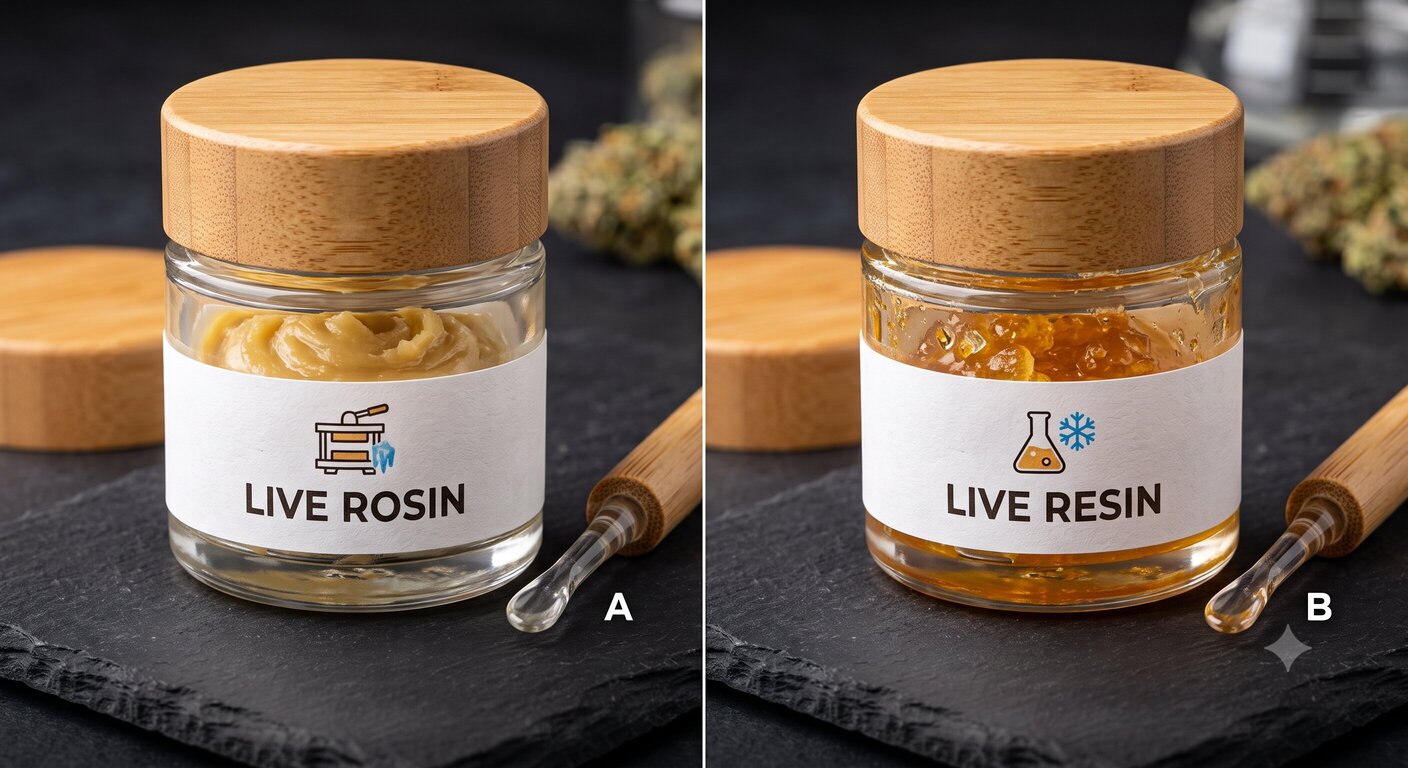
If you've spent any time browsing a concentrate menu, you've probably run into the live rosin vs. live resin debate. Both products start with fresh, flash-frozen cannabis and both deliver an intense, terpene-forward experience—but the similarities stop there. The two concentrates are made in completely different ways, sit at very different price points, and appeal to different types of consumers. Whether you're picking out a rosin dab or deciding between live resin carts and rosin carts at the dispensary, understanding the difference will help you choose more confidently and spend your budget wisely.
This guide breaks down the rosin vs. resin conversation in plain language: how each is made, what to look for on a menu, and which one makes sense for your goals.
Rosin Explained
Before diving into the comparison, it helps to understand what each product actually is. Both are cannabis concentrates that start with fresh-frozen plant material—flower or hash that is harvested and immediately frozen to lock in volatile terpenes. The rosin vs. resin split comes down entirely to how that frozen starting material is processed.
What Rosin Explained Means and Why It Matters
Live rosin is a solventless rosin concentrate made without any chemical solvents. Fresh-frozen cannabis or ice water hash (often called full-melt or hash rosin) is pressed under heat and pressure—essentially squeezed until the resinous oil separates from the plant. Because no butane, propane, or CO₂ is involved, the final product carries only what the plant naturally produced: cannabinoids, terpene-rich extracts, and minor compounds. Live resin, on the other hand, is made by running a solvent (typically butane or hydrocarbon) through fresh-frozen flower. The solvent strips the desired compounds from the plant, and the resulting solution is then purged under vacuum heat to remove residual solvent, leaving behind a potent, flavorful extract.
The distinction matters because the production method affects flavor complexity, residual solvent potential, and—most visibly—price. Live rosin is one of the most labor-intensive concentrates on the market, which is why it consistently commands a premium. Live resin is also high quality but is more scalable to produce, making it more accessible at most dispensaries. On the cartridge side, the choice between vape pens running distillate, live resin, and rosin carts comes down to how much flavor and process transparency matter to you."
What to Look For or Ask About in Store or on the Menu
When shopping for rosin concentrates or live resin at REBUD, a few simple questions go a long way:
Starting material: Was this made from flower, trim, or fresh-pressed hash? Hash rosin from ice water extraction is generally considered the highest-tier solventless option.
Texture/form: Rosin often comes as badder, jam, or sauce. Live resin commonly appears as sugar, sauce, or in cartridge form.
Batch date and cure: Freshness matters—terp profiles degrade over time. Ask when the batch was processed or check the label.
Lab testing: Look for a certificate of analysis (COA) showing cannabinoid and terpene percentages, as well as a residual solvent test for live resin products.
Live Resin Carts vs Rosin Carts
Cartridges are where the live rosin vs. live resin conversation gets most practical for everyday consumers. Vape carts are convenient, discreet, and easy to dose—but not all carts are made the same. Understanding what's inside the cartridge helps you match the product to your preferences and your budget.
What Live Resin Carts vs Rosin Carts Means and Why It Matters
Live resin carts use hydrocarbon-extracted live resin as the oil base. Because the extraction preserves a full spectrum of terpenes and cannabinoids from fresh-frozen flower, live resin carts tend to taste significantly more authentic and complex than standard distillate carts—often at a comparable price point. This makes them a popular step-up option for consumers transitioning away from distillate.
Rosin carts—sometimes called solventless rosin carts—use live rosin or a rosin-derived oil, which means no solvents ever touch the product. The flavor profile is often described as cleaner, more nuanced, and truer to the original strain. The trade-off is cost: rosin carts can run 20–50% more than live resin carts, and the viscosity of solventless oil requires different hardware (usually ceramic cores) to vaporize cleanly.
What to Look For or Ask About in Store or on the Menu
Oil type on the label: Confirm the cart says "live resin" or "live rosin/solventless"—not just "full spectrum" or "cannabis oil," which can mean distillate with added terpenes.
Hardware quality: Ceramic coil carts preserve flavor better than cotton wick designs, especially for thick rosin oil.
Brand transparency: Reputable producers list the starting material (e.g., "made from fresh-frozen Gelato #41") and publish COAs.
Price per gram: Live resin carts are typically $35–$55/0.5g; rosin carts run $50–$80/0.5g at most LA dispensaries. Factor in potency and session count, not just the upfront price.
Solventless Cannabis Guide
The term "solventless" gets used frequently on dispensary menus and marketing materials, but it's worth understanding what it actually means—and what it doesn't. This section is part of a broader solventless cannabis guide for shoppers navigating the premium end of the concentrate market.
What Solventless Cannabis Guide Means and Why It Matters
Solventless extraction refers to any method that separates trichomes or resin from the plant using only mechanical force, water, heat, and pressure—no chemical solvents. The main solventless formats you'll encounter are:
Dry sift / kief: Mechanically sieved trichome heads; simpler and less refined than other methods.
Ice water hash (bubble hash): Cannabis agitated in ice water; trichomes separate and are collected on mesh screens. The resulting hash can be consumed as-is or pressed into hash rosin.
Live rosin: The premium tier—fresh-frozen flower or ice water hash pressed under low heat and hydraulic pressure. Delivers the cleanest flavor expression of all extract categories.
Solventless doesn't automatically mean "better," but it does mean the final product's quality is directly tied to the quality of the input material. There's nowhere to hide off-flavors or poor genetics with a press—you taste exactly what the cultivator grew. That's why strain selection is so critical at the solventless tier—the same press technique on legacy strains versus new exotic genetics will produce noticeably different rosin.
What to Look For or Ask About in Store or on the Menu
"Solventless" vs. "solvent-free": "Solvent-free" means solvents were used but fully purged; "solventless" means none were used at all. These terms are not interchangeable.
Micron rating on hash: If the menu lists a micron count (e.g., 73–120μ), that refers to the screen size used—finer screens typically yield cleaner, more potent hash for pressing.
Single-source vs. blend: Single-source rosin (one strain, one farm, one press run) is generally more traceable and consistent than blended batches.
How Concentrates Are Made
Concentrates can look like a confusing alphabet soup of textures and acronyms. Understanding the basics of how concentrates are made demystifies menu options and makes it easier to predict what you're getting before you buy.
What How Concentrates Are Made Means and Why It Matters
At a high level, every concentrate starts by separating the trichomes—the resinous glands on the cannabis plant—from the plant material. Trichomes contain the majority of cannabinoids (THC, CBD, CBG) and terpenes that drive potency and flavor. The extraction method determines how many of these compounds survive into the final product, how pure the extract is, and what form (badder, sauce, sugar, wax, shatter) it takes.
Here's a simplified comparison of the two main concentrate pathways:
Solvent-based (live resin, BHO, PHO): A hydrocarbon like butane or propane is passed through frozen cannabis, dissolving trichomes into a solution. The solution is then vacuum-purged to remove residual solvent. Studies show modern closed-loop extraction systems can reduce residual solvents to very low levels, but state regulations require testing for safety.
Solventless (live rosin, hash rosin): Ice water or mechanical agitation separates trichomes without chemicals. The collected hash is then pressed under calibrated heat (typically 160–220°F) and pressure (500–1,000+ PSI) to yield rosin oil.
Texture—badder, sauce, sugar, diamonds—is largely a result of post-processing: how the extract is whipped, cured, or allowed to crystallize. A live resin sauce and a live rosin badder may look similar at a glance but have fundamentally different production histories.
What to Look For or Ask About in Store or on the Menu
Process listed on label: "BHO," "PHO," "CO₂," "solventless," or "rosin press"—brands that list the process are being transparent.
Terpene percentage: Look for total terpene content on the COA. High-quality live rosin often shows 3–8%+ terpenes; live resin typically runs 1–5%.
Infused formats: The same live rosin and live resin you'd dab also fill hash holes and infused pre-rolls—a lower-commitment way to try a concentrate before committing to a full gram.
Consistency: Sauce/sugar/diamonds forms are not necessarily better than badder—texture reflects post-processing, not potency. Choose based on your preferred method of consumption.
FAQ
What Is Live Rosin vs Live Resin?
Live rosin is a solventless extract made by pressing fresh-frozen cannabis or ice water hash using heat and pressure alone. Live resin is a solvent-based extract made by running a hydrocarbon solvent through fresh-frozen flower, then purging the solvent out. Both products preserve terpenes from fresh-frozen starting material, but the production process—and resulting flavor, purity, and price—differs significantly.
How Does Live Rosin vs Live Resin Compare to Rosin vs Resin?
The rosin vs. resin distinction is the foundational version of this comparison. Traditional resin often refers to older BHO (butane hash oil) products that may use cured or dried flower. Rosin is always solventless. Adding "live" to either term means the starting material was fresh-frozen, which dramatically improves terpene retention and flavor. So live rosin and live resin are both premium tiers within their respective production categories—just with different methods getting there.
What Does Solventless Rosin Mean?
Solventless rosin (also called live rosin or hash rosin depending on the starting material) means the extract was made without any chemical solvents—only water, ice, heat, and mechanical pressure. The term is important because it distinguishes premium rosin products from "solvent-free" products, which were made with solvents but had them fully purged afterward. If you want to avoid solvents entirely, look specifically for "solventless" or "rosin press" on the label or in the COA.
Where Can I Find Live Rosin vs Live Resin Near Me in Los Angeles?
REBUD carries a rotating selection of live rosin and live resin concentrates from vetted California producers, available for in-store pickup and delivery across Los Angeles. Go to the REBUD menu to see what's currently in stock, filter by strain or format, and compare options side by side. Our Cannabis Academy glossary hub also has definitions for any terms you encounter on the menu that aren't covered here.