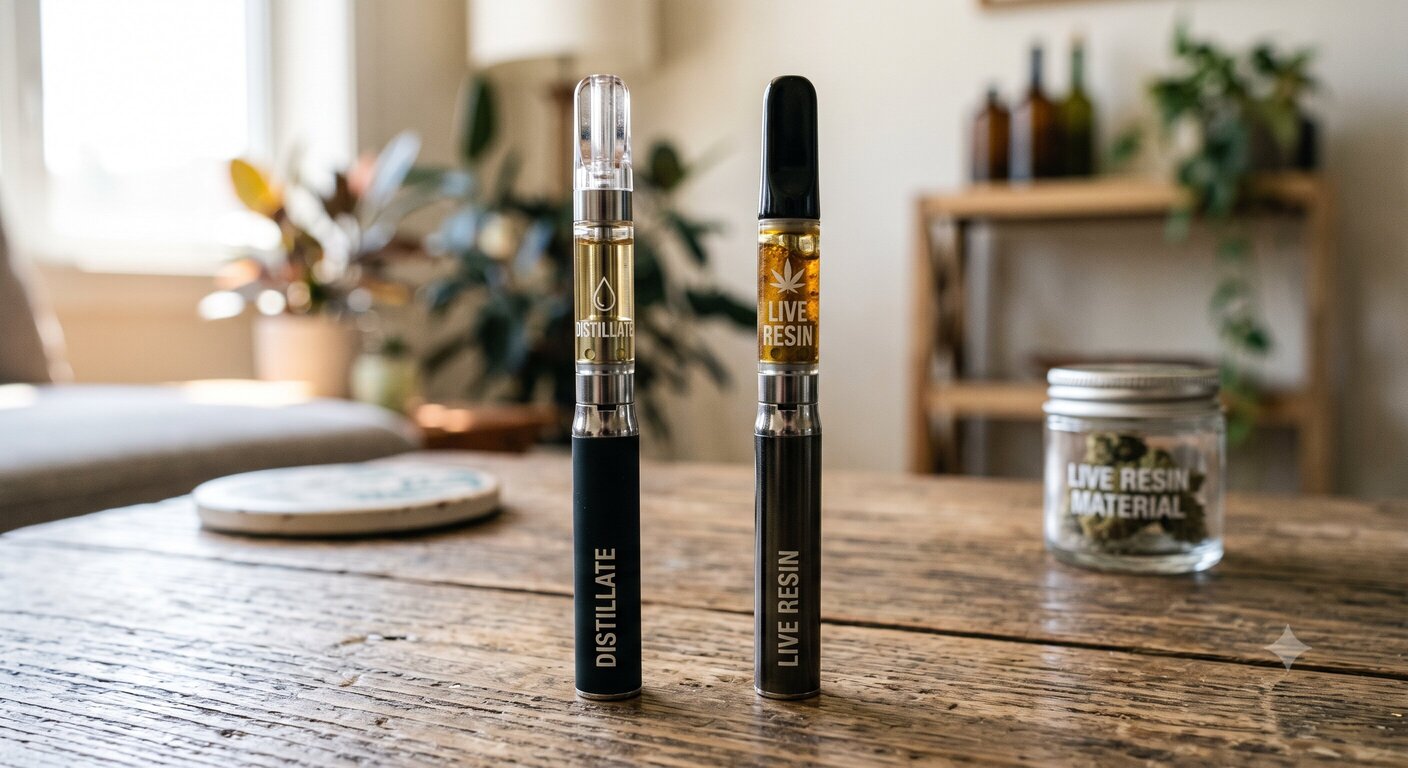
If you've browsed a California dispensary menu lately, you've probably noticed that vape cartridges don't all carry the same label. Some say distillate. Others say live resin. A few might say live rosin or cured resin. These aren't just marketing terms — they describe fundamentally different products made through different processes, with different flavor profiles, potency levels, and price points.
This guide breaks down the live resin vs distillate comparison in plain language so you can walk into a store — or load up the Rebud menu — knowing exactly what you're looking for and why it matters.
Live Resin Carts vs Distillate Carts
Both live resin carts and distillate carts are cannabis vape products designed for use with a battery or vape pen, but they diverge sharply in how they're made and what ends up in the cartridge. Understanding those differences gives you a much better sense of what to expect before you buy.
Flavor and Smell
Live resin carts are widely regarded as the more flavorful option. Since the cannabis is flash-frozen immediately after harvest — before it's ever dried or cured — the full terpene profile of the plant is locked in. Terpenes are the aromatic compounds responsible for the distinctive smells and tastes of cannabis; research published by Leafly and others notes that they also interact with cannabinoids to shape the overall experience. Whether you're choosing between legacy strains vs. new exotic genetics, live resin faithfully expresses the natural character of the cultivar in ways few other concentrate formats can match.
Distillate, by contrast, has its terpenes largely stripped away during refinement. Manufacturers often re-add botanical or cannabis-derived terpenes afterward, but the resulting flavor is typically simpler and less complex than what you'd get from live resin. This isn't necessarily a dealbreaker — some consumers prefer a cleaner, more neutral taste — but the difference is real.
Potency
On paper, distillate wins the potency race. A standard distillate cart commonly registers 85–95% THC — making it one of the most concentrated cannabis extracts available in vape form. Live resin carts generally land in the 60–80% THC range, though they retain a broader spectrum of cannabinoids and terpenes.
That terpene-rich, full-spectrum profile is often associated with what's called the entourage effect — the idea that multiple plant compounds may work together to shape the overall character of a cannabis experience. It's a key reason why many experienced consumers gravitate toward live resin despite the lower THC percentage on the label.
Extraction Process
Distillate is produced through a multi-stage refinement process: plant material is extracted with solvents, the crude oil is then purified and distilled repeatedly until a highly concentrated THC fraction remains. The result is a clear, near-odorless oil with very high cannabinoid content but minimal terpenes or minor cannabinoids.
Live resin follows a different path. Freshly harvested cannabis is immediately flash-frozen to prevent terpene degradation, then extracted using light hydrocarbons such as butane or propane. The lower-temperature extraction preserves the delicate volatile compounds that give live resin its distinct aroma and flavor.
It's also worth knowing the distinction when comparing Live Rosin vs. Live Resin: rosin starts with the same fresh-frozen material as live resin but uses heat and mechanical pressure rather than chemical solvents to extract the oil. The result is a solventless concentrate that many consumers see as the cleanest option — and rosin carts tend to reflect that premium in their price.
Effects
Distillate vapes tend to deliver a fast-acting, potent THC experience. Because distillate is stripped down to mostly THC, the effect profile is relatively predictable and straightforward.
Live resin vapes, with their richer blend of cannabinoids and terpenes, often feel more nuanced. Many users describe the experience as fuller or more layered compared to distillate — though individual responses vary widely depending on tolerance, consumption habits, and the specific cultivar. No vape product is guaranteed to produce a specific outcome, and claims about guaranteed effects aren't something we'd put on a label.
Price Differences
Distillate cartridges are typically the most budget-friendly option. The production process is highly scalable and yields a consistent product, which keeps costs down. Live resin carts sit in the mid-to-upper price range, reflecting the more labor-intensive extraction process and higher-quality starting material.
Rosin carts — solventless and made from fresh-frozen material — command the highest prices. Beyond the oil itself, hardware matters too: a ceramic cart tends to deliver better, cleaner vapor than metal-coil alternatives at any price point, and is worth looking for regardless of which extract type you choose.
How to Decide Which Is Best for You
Choosing between live resin and distillate comes down to three questions: What do you value most — flavor, potency, or price? How often do you vape? And are you open to exploring other concentrate formats?
Flavor first? Live resin is the clear choice. The preserved terpene profile makes every hit richer and closer to the experience of smoking quality flower.
Maximum THC on a budget? A high-quality distillate vape is reliable and widely available. Look for brands that re-add cannabis-derived terpenes for a better taste profile.
Cleanest, most full-spectrum experience? Explore rosin carts or live rosin options. They're the most artisanal end of the vape products spectrum and tend to attract the most discerning concentrate consumers.
The Rebud menu lets you filter by category, format, brand, and price range, making it easy to zero in on exactly what fits your preferences and budget before you add anything to your cart.
How Vape Cartridges Work
Understanding the hardware behind a cannabis vape pen helps you get the most out of any extract type — and avoid common pitfalls like buying an incompatible cartridge or burning good oil on too high a setting.
Hardware Basics — Ceramic Coils, Battery Types
A vape cartridge contains cannabis oil in a small chamber connected to a heating element — the coil — and a mouthpiece. When you draw from the pen, the battery activates the coil, which heats the oil just enough to vaporize it. Ceramic coils are the preferred standard for quality carts because they heat evenly and gently, produce cleaner flavor, and are well-suited for thicker oils like live resin. Older metal-wick coils can burn the oil at higher temperatures and introduce an unpleasant, harsh taste.
Most cartridges use the 510-thread format — the industry standard — which means they're compatible with any 510 battery. Some brands, including STIIIZY, use proprietary pod systems that require a brand-specific battery. Always check compatibility before purchasing, especially if you're adding a standalone cartridge to an existing setup.
Variable-voltage batteries give you control over the temperature. Lower voltage settings (around 2.4–2.8V) are generally better for flavor-forward live resin and rosin carts. Higher settings can produce more vapor but risk burning delicate terpenes.
What to Look For or Ask About in Store or on the Menu
When browsing or speaking with a budtender, useful questions include: Is this a full-spectrum oil or a refined distillate? Are the terpenes cannabis-derived or botanical? What coil material does the cart use, and is the hardware included or sold separately? The California Department of Cannabis Control also maintains consumer resources on what legal vape products must contain and disclose. Getting clear answers to these questions up front helps you match your purchase to your actual preferences.
Vape Safety Basics
California operates one of the most regulated cannabis markets in the world. Shopping at a licensed retailer like Rebud means every vape product on the menu has passed state-mandated testing before it reaches the shelf.
What to Check Before Buying (Testing, Additives)
All vape cartridges sold at licensed California dispensaries must be tested by a state-licensed laboratory for potency, pesticides, residual solvents, heavy metals, and microbial contaminants — before they can be sold. Look for a QR code or batch number on the packaging; reputable brands publish their Certificates of Analysis (COAs) online so you can verify test results independently.
Additive safety is another consideration. The wave of vaping-related lung illnesses reported in 2019–2020 was largely traced to vitamin E acetate — a cutting agent found almost exclusively in unlicensed, illicit-market products. California's licensed market prohibits this additive. Buying from a licensed dispensary is your clearest line of protection against adulterated products.
What to Look For or Ask About in Store or on the Menu
Ask your budtender to pull up the lab results for any cartridge you're considering. You can also search most brand names alongside "COA" to find their published test data. Avoid any vape product that lacks visible testing documentation, looks tampered with, or originated outside a licensed California retailer — regardless of price or packaging.
At Rebud, staff are trained to walk you through product details including testing status, extract type, and hardware specs. If anything about a product isn't clear, it's always worth asking before you buy.
FAQ
Is Live Resin Better Than Distillate?
Neither is objectively better — they're suited to different priorities. Live resin delivers more complex flavor and a fuller terpene and cannabinoid profile. Distillate delivers higher raw THC concentration at a lower price point. If flavor and full-spectrum effects are most important to you, live resin is worth the extra cost. If potency and value are your priorities, a well-made distillate cart gets the job done.
How Does a Weed Vape Compare to a Cannabis Vape Pen?
A weed vape and a cannabis vape pen refer to the same thing: a battery-powered device that heats cannabis oil to the point of vaporization. The terms are completely interchangeable. What matters more than the name is what's inside — distillate, live resin, live rosin, or cured resin — and whether the hardware (coil type, battery voltage) is suited to the oil you're using.
What Does Distillate Vape Mean?
A distillate vape is any vape cartridge or disposable weed vape loaded with distillate oil — a highly refined THC extract that's been stripped of most plant compounds to produce a very high-potency, neutral-tasting oil. Distillate vapes are one of the most widely available formats in California dispensaries, typically come in at a lower price point than live resin, and are a solid starting point for consumers who are new to vaping cannabis.
Where Can I Find Weed Vapes Near Me in California?
If you're in Los Angeles or within Rebud's delivery area, you can browse a full selection of vape products directly on the Rebud menu — including live resin vapes, distillate carts, disposable weed vapes, rosin carts, and branded pod systems from names like STIIIZY, PLUGplay, Heavy Hitters, and more. Order online for delivery, or visit one of Rebud's LA dispensary locations to speak with a budtender in person.