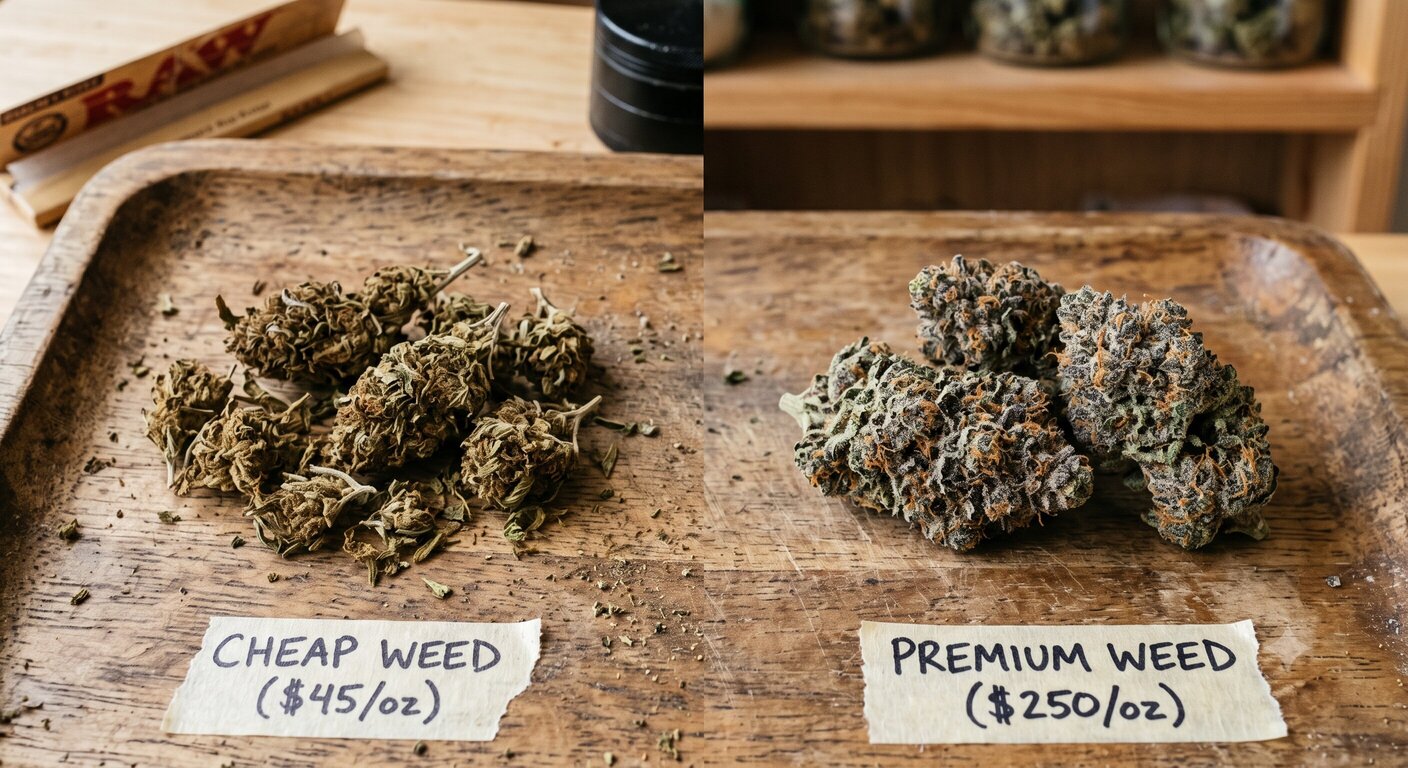
The gap between cheap weed vs premium weed has narrowed considerably in California’s mature cannabis market — but it hasn’t disappeared. With licensed dispensaries competing on price, quality, and selection, it can be hard to know whether you’re getting a great deal or quietly sacrificing something you’ll actually notice. This guide walks through what the difference really means, how to evaluate cannabis products at a glance, and when it’s genuinely worth spending more.
Whether you’re ordering delivery or browsing in person at a Rebud cannabis dispensary, you’ll leave with a clearer sense of where your money actually goes — and how to find real cannabis value at any budget.
Premium Flower Guide
Understanding the premium tier is the fastest way to make sense of the broader market. Once you know what earns a product the top-shelf label, budget options become much easier to evaluate on their own terms.
What Premium Flower Means and Why It Matters
Premium flower is typically defined by a combination of cultivation method, genetics, cure process, and lab-verified cannabinoid and terpene profile. In California’s mature market, where price compression cannabis has been a consistent trend since legalization, premium increasingly points to craft-scale production: small-batch grows, hand-trimming, extended cure times, and transparent third-party testing.
Cannabis products in the top tier generally show higher terpene percentages — often above 1.5–2% total — dense trichome coverage, and a complex, pungent aroma. These attributes are commonly associated with a fuller sensory experience, though research on the direct relationship between price and subjective effect is still developing. For shoppers interested in reading cannabis lab tests, California’s Department of Cannabis Control mandates a full testing panel for all legal products, including potency, pesticide residue, heavy metals, and microbials. Premium brands typically publish results that go beyond the minimum.
What to Look For or Ask About in Store or on the Menu
When evaluating premium flower, keep these signals in mind:
Terpene percentage: A COA (Certificate of Analysis) showing total terpenes above 1.5% is a useful starting benchmark.
Harvest and cure date: Fresher flower — cured within the last 3–4 months — retains more aroma compounds and moisture.
Trim style: Hand-trimmed buds preserve more trichomes than machine-trimmed.
Packaging: Nitrogen-sealed or vacuum-sealed containers slow oxidation and degradation.
If the label and numbers feel overwhelming, try shopping by desired experience instead. Tell the budtender whether you want something calming, energizing, or social — and let the terpene profile guide the recommendation rather than the THC number.
How to Judge Quality
Knowing what to look for removes most of the guesswork from the cheap weed vs premium weed debate. These signals apply whether you’re picking up value flower or spending top dollar on the shelf.
What Judging the Quality Means and Why It Matters
Quality in cannabis is multidimensional. THC percentage is the most visible number on a legal label, but research consistently shows it is one of the weaker predictors of consumer satisfaction. Terpene compounds like myrcene, limonene, and linalool play a meaningful role in the overall experience — an idea commonly referred to as the entourage effect. Leafly’s reporting on the subject provides a clear consumer-friendly breakdown.
Value flower often comes from the same cultivars as premium lines but may be machine-trimmed, slightly older, or from a different harvest run. That doesn’t make it bad — it reflects a different production tier. Understanding this distinction is the foundation of smart cannabis value shopping.
For those exploring cannabis microdosing — typically defined as consuming 1–5mg of THC at a time — label accuracy and consistency may matter more than premium credentials. A predictable, well-labeled product at a lower price point often serves microdosers better than a high-THC top-shelf option. The Cannabis Academy glossary defines microdosing as using the minimum effective dose to achieve a desired outcome without unwanted intensity, making it a useful reference for new consumers.
What to Look For or Ask About in Store or on the Menu
Smell: Fresh, pungent flower with a complex aroma is one of the most reliable on-the-spot quality signals.
Appearance: Dense, trichome-coated buds with even coloring. Overly dry or browning flower suggests age.
COA availability: Any reputable brand should have a publicly accessible Certificate of Analysis. Brands that make these easy to find demonstrate a commitment to transparency.
Reading lab results: When reading cannabis lab tests, check terpene totals, water activity (below 0.65 is the ideal range), and moisture content alongside THC and CBD figures. Project CBD offers a helpful reference on interpreting cannabinoid panels.
What Makes Cannabis More Expensive
The premium cannabis price gap isn’t arbitrary. Several genuine cost drivers separate a $20 eighth from a $60 one — and understanding them makes it easier to decide when the difference is worth it for you.
What Expensive Cannabis Means and Why It Matters
California’s legal market has experienced significant price compression at the retail level — but production costs haven’t fallen at the same rate. Here’s what actually drives the price of cannabis products:
Cultivation method: Indoor grows under controlled lighting produces consistent, dense buds but costs significantly more to operate than greenhouse or outdoor farms. Outdoor and light-deprivation cannabis often delivers excellent quality at lower price points.
Genetics and licensing: Proprietary or in-demand cultivars command higher prices. Brands that invest in breeding programs or hold exclusive genetics pass those costs to consumers.
Labor intensity: Hand-trimming, small-batch processing, and extended cure periods require substantially more labor per unit — and that shows up clearly at the register.
Brand equity: Some of the premium cannabis price reflects marketing investment, packaging design, and brand positioning rather than flower quality. This is a feature of all mature consumer markets, not a flaw.
Compliance and testing: California’s mandatory testing regime adds cost to every legal product. Brands running additional voluntary panels pay more and often communicate that commitment visibly on packaging.
Budget cannabis is typically produced at scale with faster turnarounds and mechanized processing. It is not inherently inferior — it reflects different production economics. The mandatory testing floor means all legal cannabis products meet California’s safety standards regardless of shelf price.
What to Look For or Ask About in Store or on the Menu
Ask about cultivation source: Outdoor and greenhouse cannabis frequently represents outstanding value flower. Many sought-after genetics are now available in sun-grown formats at a fraction of indoor prices.
Compare price-per-milligram for edibles and vapes: Sticker price can be misleading. A $25 package with 100mg may deliver more value than a $40 package with 50mg.
Look for brands investing in growing over packaging: Producers that spend on cultivation and testing rather than premium box design often deliver outsized quality for the price.
For concentrates: Solventless products like rosin and hash cost more due to the extraction method. This is one area where the premium reflects a genuine and verifiable process difference.
FAQ
What Is Cheap Weed vs Premium Weed?
Cheap weed vs premium weed refers to the price and quality tiers that exist across legal cannabis markets like California. Budget cannabis typically comes from larger-scale operations with mechanical processing, while premium flower is commonly associated with small-batch craft cultivation, extended curing, and higher terpene profiles. In LA’s mature market, all legal cannabis products must pass California’s mandatory safety and potency testing, so both tiers are regulated and compliant.
How Does Cheap Weed vs Premium Weed Compare to Cannabis Value?
Cannabis value is about what you receive relative to what you pay. A $25 eighth with a rich terpene profile and a recent harvest date may deliver more value than a $50 eighth with a high THC number but an older cure. Rather than using price as a shortcut for quality, focus on lab results, terpene content, and shopping by desired experience. At Rebud, the menu spans multiple price tiers so every customer can find real value across all cannabis products.
What Does Budget Cannabis Mean?
Budget cannabis refers to cannabis products priced in the lower tier of California’s legal market — typically under $30 for an eighth of flower. All legal cannabis must pass the same state-mandated safety and potency testing regardless of price, so budget options are fully regulated. The distinction usually comes down to production scale, packaging investment, and sometimes terpene complexity — not safety or legal compliance.
Where Can I Find Cheap Weed vs Premium Weed Near Me in California?
If you’re in California and looking for both value and premium options in the same place, Rebud has five dispensary locations across the city — North Hollywood, Highland Park, Sylmar, Westwood, and San Pedro — plus delivery covering much of LA and Orange County. Browse the full menu at rebud.com to shop by price tier, product type, or brand. Whether you’re exploring cannabis microdosing, trying top shelf weed for the first time, or stocking up on reliable everyday cannabis products, the Rebud team can help you find the right fit.